5 Things to Include in a Travel Nurse Contract



During staffing shortages, it may be in your facility’s best interest to hire travel nurses — experienced nurses available to quickly fill urgent staffing needs. Travel nurses require little training and may be ready to staff your unit with just a few weeks’ notice. If your facility is interested in working with these flexible clinicians, you’ll need to learn how to enter into a travel nurse contract.
Traveling nurse contracts are legal agreements between the facility and nurse outlining the expectations for the contract period. Creating a contract template with all the essential details will help you save time getting travelers into your facility. Here’s a look at what you can put into your contracts to help protect your facility and ensure a positive working relationship.
How Does Travel Nursing Work?
Healthcare facilities often contract with travel nurses during periods of staff shortages and will work with recruiting agencies or post to job boards catering to nursing professionals to find candidates. The contract, signed with either an agency or directly with the nurse, will state the location, hours, job duties, length of assignment, expectations, and other pertinent details.
Facilities typically have policies in place for contingencies such as concerns about safety, the inability to complete an assignment, or early contract termination. Facilities also may provide a stipend for temporary housing and a daily per diem for meals.
Reasons for Entering Into a Travel Nurse Contract
Travel nurses, facilities, and sometimes third parties (such as staffing agencies) will enter into a travel nursing contract to create a legally binding agreement covering the terms and conditions of the working relationship for a nurse’s assignment. Travel nurse agencies communicate the nurse’s requests — such as requested time off or shift preferences — to the facility, which then decides whether to agree to them or not.
If you’re in charge of approving long-term or short-term travel nurse contracts, be prepared to negotiate. You’ll also need to be familiar with what makes a travel nurse’s gig unique.
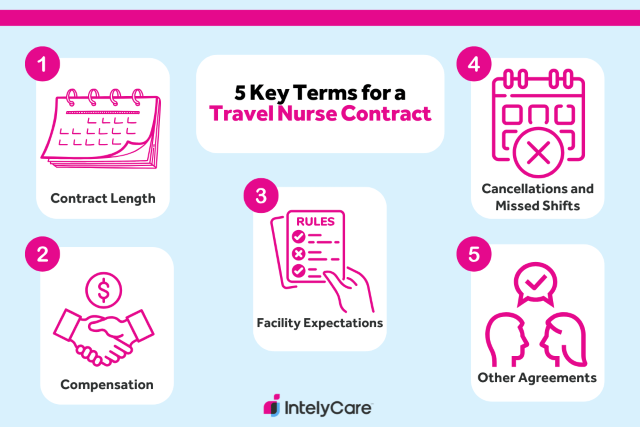
5 Key Terms for a Travel Nursing Contract
Start by making the contract personal; include the nurse’s legal name and permanent address and the unit, facility, and address for the assignment. Then, create sections to cover the details surrounding the expectations of the role. Here are five key areas that you should consider including in your contract:
1. Travel Nurse Contract Length
The standard travel contract is 13 weeks; but even for shorter, 4-week travel nurse assignments, be sure to define the expectations in the contract. Consider adding details such as:
- Contract start and end dates.
- Nurse’s contracted time off.
- Schedule expectations for shift type, weekends, and holidays.
- On-call requirements.
- Number of shifts per week.
You can also add “total contracted hours” to detail how many hours the nurse will work. For example, the nurse would be expected to work 288 hours for 8-week travel nurse contracts. If the facility promises guaranteed hours, include it here. This means the nurse can pick up a shift in the event of a cancellation.
Tip: This is a good place to specify who does the scheduling. Let the nurse know whether they’re expected to self-schedule or if their shifts are set by someone else.
2. Compensation
In addition to hourly wages, travel nurses are compensated for the costs associated with working away from home. A typical compensation package may include things like travel reimbursements, a housing stipend, and a daily per diem called “meals and incidentals.”
In this section, describe how the nurse’s total compensation package is allocated. Items to add include:
- Taxable base for contracted regular hours.
- Taxable base rate for overtime hours.
- On-call and call-back rates.
- Travel reimbursements.
- Housing stipend.
- Meals and incidentals.
You may want to detail how monthly stipends are allotted (for example, if the housing stipend is divided into weekly checks). Keep in mind that while hourly pay is taxed, payments like housing stipends are considered nontaxable income. Consider adding information like pay frequency (weekly, biweekly, etc.) and timesheet reporting to simplify the filing process for your travel nurse taxes.
3. Facility-Based Expectations
This section covers facility-specific nursing duties for the role. Clarify floating expectations, such as the potential to float to other departments.
If the facility requires vaccinations or additional certifications, list them here. It should be the traveler’s responsibility to complete mandatory items and confirm state-based licensure before starting an assignment.
4. Cancellation and Missed Shift Policies
If there is any chance of a traveler’s contract being canceled, provide a disclaimer. Occasionally, travel nurses’ contracts are canceled before or during an assignment due to:
- Budget concerns.
- A drop in patient census or overstaffing.
- The nurse’s inability to fulfill the contract.
The contract should state whether a facility can cancel a contract and when, and how far from a start date it can be canceled.
Call-out policies may also be covered in this section. If a nurse self-cancels a shift, will they be required to make up shifts? Will they lose money from the monthly housing stipend for a missed shift? You may also want to provide names and numbers of who a nurse should call on a sick day.
5. Additional Agreements
Prior to signing a contract, a hiring manager should have spoken to the travel nurse to discuss the position. If any agreements were made during the travel nurse interview process, include them here. Examples might include the following:
- Limitations on floating the travel nurse to other facilities
- Allowing for light duty due to a physical restriction
- No rotating shifts in the same week
Tip: Experienced travelers may compare travel nurse contracts before deciding on an assignment. Be flexible about honoring reasonable requests to assure the nurse will move forward with your facility.
Travel Nursing FAQs
While we’ve gone over the key components of a contract, you may still have some logistical questions about how travel nursing works and whether it will be a viable staffing option in the future for your facility. Below, we’ll answer a few more FAQs to help inform your staffing decisions.
What’s the 12 month rule for travel nurses?
If a travel assignment lasts more than 12 consecutive months, or could realistically be expected to last longer than 12 months even if it doesn’t, the IRS may no longer consider it to be temporary work. This means that travel nurses may have to pay taxes on what’s typically considered nontaxable income — such as housing stipends.
How do travel nurses find contracts?
Travel nurses are typically hired through third-party agencies contracted to help a facility fill temporary roles. Nurses reach out or apply to agencies that they want to work with. Once they establish a partnership, the agency will match them with appropriate jobs. These agencies may sometimes use job boards to advertise the openings that they’re working on filling.
Do travel nurses get free housing?
In most cases, travel nurses don’t receive fully covered housing. However, they do get a choice between taking agency/facility-arranged housing or a housing stipend. While arranged housing may sometimes be advertised as “free,” it’s usually deducted from a nurse’s overall compensation.
Can travel nurses be fired?
A travel nurse can be fired by a facility for a variety of reasons, which are usually outlined in their contracts. Nurses can also terminate their contracts, but this can make them responsible for any penalties outlined in the agreement.
Need Immediate Nurse Staffing Support? Fill Your Shifts Today
Ready to bring temporary nursing staff to your facility? Drafting a travel nurse contract can be time-consuming and tedious — but not if you partner with IntelyCare. We handle all the details, from nurse credentialing to onboarding, so you can get the nursing professionals you need when you need them.
Legal Disclaimer: This article contains general legal information, but it is not intended to constitute professional legal advice for any particular situation and should not be relied on as professional legal advice. Any references to the law may not be current, as laws regularly change through updates in legislation, regulation, and case law at the federal and state level. Nothing in this article should be interpreted as creating an attorney-client relationship. If you have legal questions, you should seek the advice of an attorney licensed to practice in your jurisdiction.