How to Get Into Nursing School: Requirements for Prospective Students



Nursing school requirements might seem intimidating or confusing if you’re just learning about the process of becoming a nurse. It takes specialized education, training, and experience to join the ranks of America’s most trusted profession. To prepare you for the challenges of nursing school, programs require that students complete courses, application forms, standardized tests, and more.
Whether you know you want to be a nurse or want to find out how to get into nursing school before making a decision, let’s go over requirements for nursing school and the process for getting into a nursing program.
How to Get Into Nursing School: 6 Essential Steps
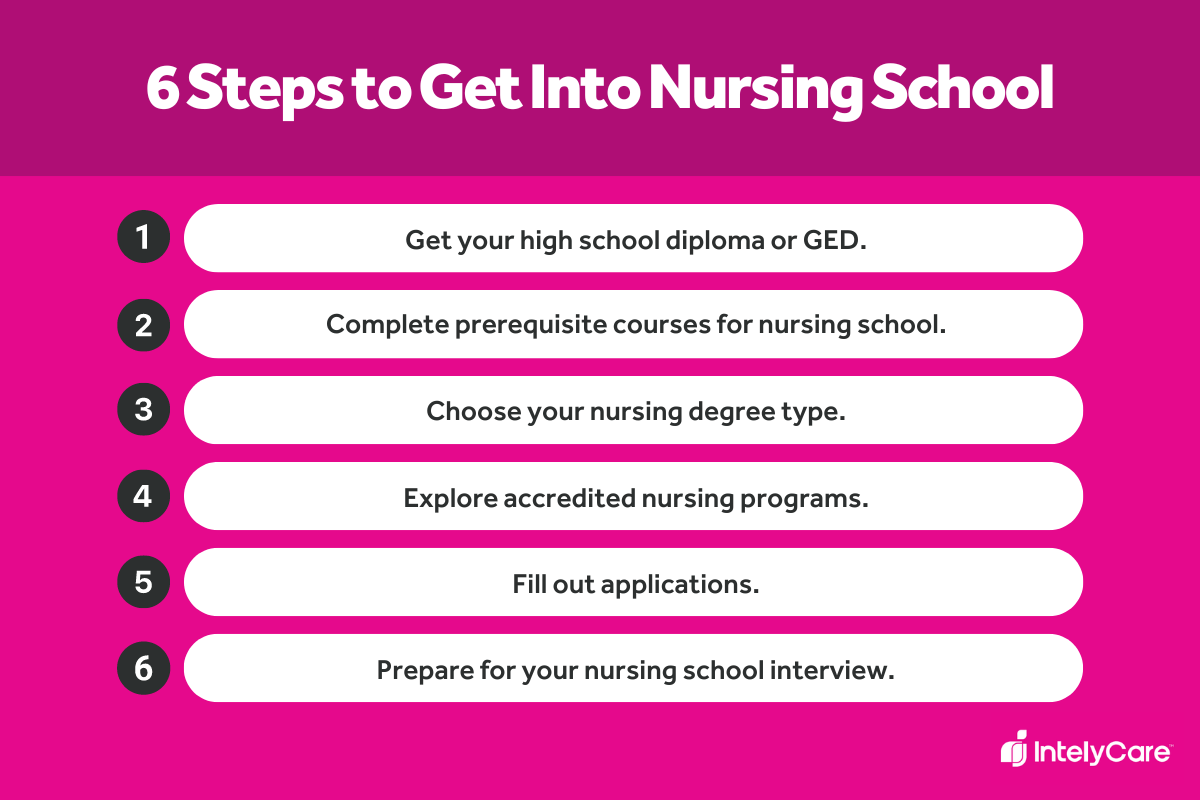
1. Get Your GED or Diploma From High School
Requirements for nursing school — regardless of the education path you pick — begin here.
2. Complete Required Courses for Nursing School
Learning how to become a nurse after high school starts here. Before beginning nursing school, you must take prerequisite courses to ensure you have a strong foundation upon which you’ll build your nursing knowledge. You can enroll in a nearby community college or four-year university to take the necessary courses.
Be ready to focus on the sciences — a pivotal element of the requirements to get into nursing school. If science courses aren’t your strength, don’t hesitate to reach out to a tutor. Such prerequisites are opportunities to hone your studying skills and academic resources. Successfully completing these classes indicates your ability to make it through the more difficult coursework down the line.
Nursing school requirements typically include the following courses:
- Anatomy and physiology: The study of the body’s structure, the relationship between body parts, and how the many facets of the body function as a whole.
- Biology: The study of living organisms
- Microbiology: The study of the biology of microscopic organisms.
- Chemistry: The study of the substances that compose matter, as well as their properties, uses, and reactions.
- English: The study of English language and composition.
- Nutrition: The study of food, nutrients, and their relationships to the human body.
- Psychology: The study of the human mind and its functions.
- Statistics: The science of analyzing numerical data in large quantities.
3. Choose Your Nursing Degree Type
One of the beauties of nursing is all the options at your fingertips, and this begins with your nursing degree. You have two choices that are among the principal levels of nursing:
- An Associate Degree in Nursing (ADN)
- A Bachelor of Science in Nursing (BSN)
Both degree programs prepare you to become an entry-level registered nurse (RN) and will provide the foundational knowledge you need. Note that the American Association of Colleges of Nursing reports that employers prefer BSN graduates. For detailed information, check out our comprehensive article on the differences between ADN vs. BSN programs.
Regardless of which degree you decide on, research individual accredited programs to see what their particular nursing school requirements are. Reach out to a program advisor for specific questions and tips about how to get accepted into nursing school.
How to Get Into Nursing School: Typical ADN Program Requirements
An associate degree in nursing is a two-year program that prepares you to be a registered nurse. It involves coursework, lab work, and clinical rotations.
Your specific nursing school requirements may differ depending on the program you choose. For example, an ADN program may allow you to complete required classes alongside your nursing courses if you complete them by graduation. What you’ll need:
- GPA: Most ADN programs require a minimum cumulative GPA of 2.0.
- High school or college courses: Common required classes for your nursing school application include chemistry, biology, math, English, and nutrition. Some schools may require a passing grade of a C or higher. Other schools may place a timeline on when these classes were completed, such as within the past five years.
- Pre-entrance exam: Some schools require a test to get into nursing school, like the TEAS or HESI exam. These tests assess a student’s general knowledge, and many schools have a minimum score required of applicants.
- Criminal background check: Many schools require completing a criminal background check before you can be accepted into the program. The main reason for this is to ensure that patients are kept safe when you are caring for them in your clinical rotations.
- Drug screening: This is often required for similar reasons as the background check — to ensure patient safety during clinical rotations.
How to Get Into Nursing School: Typical BSN Program Requirements
A Bachelor of Science in Nursing is a four-year program that prepares you to be a registered nurse. Like the ADN program, it will require a combination of coursework, lab work, and clinical rotations. The nursing school requirements for a BSN program will include many of those from an ADN program.
Some of these requirements may be university-wide, such as a written communications class. Others are specifically nursing school requirements, such as anatomy and physiology.
When selecting your program, be sure to learn about both the university requirements and nursing school requirements, as you will have to pass all classes in order to graduate. What you’ll need:
- GED: Most schools require a minimum cumulative GPA of 3.0. Some universities may be stricter and require two years of general college education before acceptance into their BSN program.
- College-level courses: Common classes include anatomy and physiology I and II (with lab), microbiology (with lab), statistics, psychology, chemistry, nutrition, biology, and written communications. You may also see criteria that require you to pass these courses with C or higher.
- Entrance exams: Just like with ADN programs, entrance exams may be required.
- Essay: Many schools require you to write a personal statement in order to be accepted into the nursing program. Some programs are especially competitive — this essay is your chance to stand out.
- Letters of recommendation: Usually two to three letters are required from past teachers or employers. Some schools will also allow personal recommendations.
- Criminal background check: You will be caring for patients during your clinical rotations. This background check ensures you are trustworthy, and patients will be safe.
- Drug testing: A drug test may also be required for similar reasons as the background check.
4. Explore Accredited Nursing Programs
To make nursing school worth it for you, make sure to choose a quality nursing program that’s the right fit. Ask yourself the following questions:
- Is it within commuting distance?
- Is diversity important to you?
- Is it affordable?
- Are there nursing school scholarships available?
The costs of nursing programs vary based on the institution. Finding a school within your means is ideal, but if your dream school is expensive, investigate scholarship opportunities and student loan forgiveness for nurses. You can also consider taking classes part-time so you can work to help fund your education. For more information, read our comprehensive guide on how to pay for nursing school.
Keep an eye out for schools with ample resources to assist students so you can feel secure in attending an institution committed to your success.
5. Fill Out Applications — Early
While each program will have its own nursing school requirements and instructions for applying, an early application is a signal of your commitment to becoming a nurse. Closely follow the instructions for each school’s admission packet and check to make sure everything is correct before submitting.
Requirements for nursing school may include transcripts, test scores, application fees, and a personal essay. When writing the latter, lean into the reasons you want to be a nurse in the first place. Do you enjoy helping others? Does the human body fascinate you? Are you attracted to the more practical benefits like workplace variety and flexibility? You can speak to nurses in your life for additional essay inspiration.
6. Prepare for Your Nursing School Interview
Once they like what they see on paper, the admissions department may want to meet you in person. Feeling nervous is understandable, but it’s also a great time to pat yourself on the back. Here are some tips to maximize your success in the interview process.
Do Your Research
- Educate yourself on the nursing industry, such as current affairs and projected trends in nursing. This info will come in handy in your practice, so your interviewer may want to know your grasp of the overall profession.
- Learn about the school’s mission and values. Put yourself in the interviewer’s shoes: Would you choose an applicant who appears lukewarm about attending your school, or an applicant who’s enthusiastic? It’s a no brainer.
- Make sure you have a firm grasp on why you chose that particular school. Feedback from friends? A reputation for excellence? Ample student support? Being invited to an interview is their way of showing interest in you, this is your chance to return the favor. Make the most of it.
Practice in Mock Interviews
Having an idea of how you’ll respond will go a long way toward impressing the admissions department. Practicing with a guidance counselor or someone else who would give valuable feedback is ideal, but if you don’t have those options, you’ve always got a mirror. Practicing alone is better than nothing.
Here are some interview topics to consider:
- Current affairs
- Why you want to be a nurse and what this profession means to you
- A general description of your personality
- Why you chose that specific nursing school
Feel Free to Ask Questions
Remember, the interview is both a school’s opportunity to assess you and your opportunity to assess them. Have your own questions in mind. Not only will you gain more insight that could impact your decision, but this also shows your interest and investment in becoming part of their institution. Below are some questions you can ask:
- What are the program’s main strengths and weaknesses?
- What academic support do you provide students?
- How would you describe student life outside of academics?
- What are some hospitals that host students for clinical rotations?
- What makes a student successful here?
- How does this program help with job placement after graduation?
Expert Tip: Take Care of Yourself
Not being in the right mental state is enough to throw you off, no matter how much you’ve practiced. Ensure your body’s needs are met, and that you have calming techniques to quell the butterflies. Get a good night’s rest, make sure you’ve had enough to eat, and address any aches and pains. Is an issue from your personal life on your mind? Find a way to set it aside long enough for the interview. You’ve got this, so make sure it shows.
What Happens After Graduation?
After you graduate from nursing school, you will be ready to take the NCLEX exam. Passing this test will give you the green light to apply for your long-awaited nursing license and make you eligible for nursing jobs.
How to Get Into Nursing School FAQ
How hard is it to get into nursing school?
Nursing school requirements vary from institution to institution, and some programs are more competitive than others, so you may want to apply to more than one.
How can I boost my chances of getting into nursing school?
Volunteering for a healthcare or disaster relief provider is a great way to show your commitment to nursing. Explore opportunities at local health clinics, hospitals, or long-term care facilities. You can also look at volunteer openings at larger organizations like Doctors Without Borders, the American Red Cross, or AmeriCares.
Working as a certified nursing assistant (CNA) is another way to make your application stand out. The requirements can take as little as a few months to complete. Getting hands-on experience as a CNA helps prepare you for a career in healthcare. Plus, you can offset the costs of nursing school with the pay you earn in CNA jobs.
What GPA do you need to get into nursing school?
Every school will have its own entry requirements when it comes to grades, but typically, an ADN program requires a cumulative GPA of at least 2.0, and a BSN requires a cumulative GPA of at least 3.0.
Is it possible to work during nursing school?
Yes! It takes time management skills, but many students work during school. And if you’re looking for opportunities to earn an income while gaining experience, there are many great jobs for nursing students.
What is the fastest way to become a nurse?
The fastest way to qualify for RN licensure is through accelerated nursing programs. These are for people who have college degrees in other subjects, and are willing to make the time and effort commitment to complete a nursing degree in just a year.
What if you don’t qualify for accelerated tracks? Consider becoming an LPN, which takes about a year. Learn more about fast ways to become a nurse.
Why is it so hard to get into nursing school?
Nursing schools turn away thousands of qualified students due to shortages in nurse educators. It can be really discouraging, but if you don’t get in the first time, that doesn’t mean you aren’t meant to be a nurse. Try taking more courses, improving your standardized test scores, and potentially applying again or to other schools.
What’s the average income for RNs?
Completing nursing school requirements could help set you up for a stable income later on — the average registered nurse salary in the U.S. is $98,430 per year. New graduates typically start with a lower salary, but experience, certifications, and specialty expertise can help you earn more.
Location is also a major factor in determining what you earn as a nurse. Check out RN roles in the states with the highest pay for RNs:
- RN jobs in California
- RN jobs in Hawaii
- RN jobs in Oregon
- RN jobs in Washington
- RN jobs in Massachusetts
Put Your Nursing Knowledge to Work
Nursing school requirements help prepare you for career success. So can we. Need help finding a job you love? Learn how IntelyCare can send you personalized job notifications based on your preferences.
Ayana Dunn, BSN, RN, contributed to the writing of this article.