HIPAA Training Resources: Facility Guide and FAQ



Healthcare technology improves the way patients get care. Tools like electronic health record (EHR) systems improve access to care by allowing healthcare providers to obtain important health information wherever they are. However, with improved accessibility to sensitive information comes a greater need to protect patients’ privacy and security, as required by HIPAA. Training resources for your staff are key to ensuring proper handling of this data.
As a healthcare leader, you can ensure patient privacy is protected at your facility by committing to effective training procedures for healthcare and administrative staff. Here, we’ll explain the importance of HIPAA compliance and what to include in a training program.
HIPAA Overview
The Health Information Portability and Accountability Act (HIPAA) was enacted in 1996 by Congress to improve efficiency and effectiveness in the U.S. healthcare system. HIPAA is a federal law that establishes national standards to protect sensitive health information from being shared without an individual’s consent or knowledge. It’s regulated by the Department of Health and Human Services (HHS), which adopted national standards for unique health identifiers, security, and electronic transactions and code sets.
Advancements in healthcare technology led to HIPAA provisions, which mandate the adoption of federal privacy protections for electronic health information. The 5 basic rules of HIPAA were created to set national standards for handling protected health information (PHI) in an electronic format.
|
|
|
|---|---|
|
The Privacy Rule |
Applying to all formats and handlers of PHI, this rule sets the standard for who’s allowed to access PHI and how. It also protects patients’ rights to their own information. |
|
The Security Rule |
Focused primarily on EHR, this rule mandates administrative, physical, and technical safeguards for PHI. |
|
The Enforcement Rule |
Compliance and investigations are provisioned here, covering topics such as civil penalties and the handling of violations of Administrative Simplification Rules. |
|
The Omnibus Rule |
This rule builds on HIPAA standards, integrating provisions from the Health Information Technology for Economic and Clinical Health (HITECH) Act to strengthen privacy and security protections of PHI. |
|
The Breach Notification Rule |
Finalized by the Omnibus rule, this dictates how healthcare organizations should handle data breaches, or the unauthorized use or disclosure of sensitive information (like ensuring that impacted individuals are notified). |
What Is HIPAA Compliance?
Being HIPAA compliant means covered entities adhere to the standards and implementation practices of HIPAA regulations. Failure to comply can result in civil monetary penalties, with fines ranging from $100 to $50,000 per violation. Criminal offenses, which are handled by the Department of Justice, may result in imprisonment.
HHS’s Office for Civil Rights (OCR) conducts compliance audits and investigates complaints related to patient safety confidentiality laws. All covered entities and business associates may be subject to an OCR audit. During the audit selection process, an OCR representative will reach out to your organization to collect information such as your facility size, how many patients you see a year, and your business associates (persons or entities that use protected health information to perform certain functions on behalf of a covered entity, such as claims processing, billing, and data analysis).
Healthcare employers can prepare for periodic audits by:
- Performing risk assessments.
- Providing staff education about HIPAA Privacy and Security Rules.
- Being prepared for OCH audits.
- Employing a privacy officer or security officer to create a HIPAA Compliance Checklist for the organization.
- Maintaining a record of healthcare employee training completion.
Who Needs Compliance Training?
Covered entities — which include healthcare organizations, institutions, and individuals — must comply with HIPAA’s privacy and security rules. Business associates are only required to comply with the security rule. As part of a compliance program, healthcare employers must certify their workforce in the appropriate training. This means that you should be providing HIPAA training for nurses, physicians, and any other clinical and administrative staff who come in contact with PHI. New members at a covered entity must undergo HIPAA training within a reasonable time period of joining the workforce.
Where Can Facilities Find HIPAA Training Resources?
There isn’t one standardized HIPAA staff training resource that covers the broad range of healthcare entities that need to comply with HIPAA rules. To create a program, healthcare facility leaders can gather information from resources such as:
- HHS’s HIPAA training materials
- The free HIPAA compliance checklist
- Health IT privacy and security resources for providers
- Certification courses providing HIPAA training resources online
How Do You Create a HIPAA Compliance Training Program?
As you begin gathering HIPAA training resources to create a program for your staff, establish course objectives that align with program goals. Consider using elements of the compliance checklist as a guideline, and follow these seven steps:
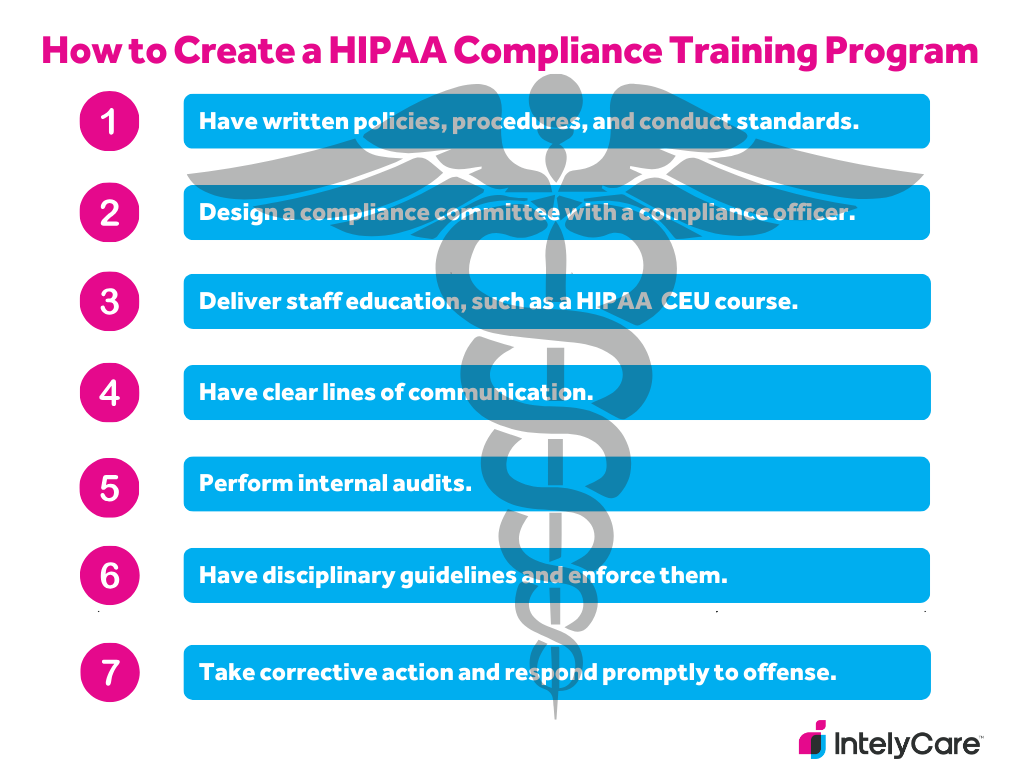
- Have written policies, procedures, and conduct standards.
- Design a compliance committee with a compliance officer.
- Deliver staff education such as a HIPAA certification for healthcare workers CEU course.
- Have clear lines of communication.
- Perform internal audits.
- Have disciplinary guidelines and enforce them.
- Take corrective action and respond promptly to offense.
What to Include in Compliance Training
Whether you’re creating HIPAA training for nurses and physicians, or for your medical billers and administrative staff, remember to keep the course concise and simplified so employees can get a clear understanding of the content. HIPAA rules are complex, so create learning material that covers the basic rules and how they affect your organization. Periodic internal compliance audits help leaders evaluate the program, while ensuring compliance within your organization.
Consider including the following sections in HIPAA staff training at your healthcare facility:
- HIPAA overview
- HITECH Act overview
- The basics of HIPAA security and privacy rules
- Consequences of violating the rules
- Social media best practices
- Security awareness and phishing
- How to be a HIPAA-compliant employee
As healthcare technology evolves, HHS may make updates to HIPAA regulations that affect your facility. Employers should provide staff with refresher training to see the updates if there are changes made to HIPAA rules.
Stay Updated on Healthcare Compliance
Providing HIPAA training resources for healthcare staff is essential to maintaining compliance with federal regulations and protecting patients’ privacy and security. Learn more ways to protect patients at your facility with IntelyCare’s expert-informed facility guides and best practice recommendations.