CRNA School Requirements: How to Get Into CRNA School


As a certified registered nurse anesthetist (CRNA) you’ll take on one of the most advanced and rewarding roles in the nursing profession — administering anesthesia, monitoring patients during sedation, and supporting them through the recovery process. But before you can step into this role, you’ll need to meet a set of rigorous CRNA school requirements and undergo extensive training designed to prepare you for the challenges and responsibilities of this high-level career.
With tens of millions of anesthetics administered each year in the U.S., your future skills are in great demand. In this guide, we’ll outline the requirements for CRNA school admission and offer practical tips to help you get started.
CRNA School Requirements: A Snapshot
Starting in 2025, all new nurse anesthetists will be required to hold a doctoral degree to practice. The two main pathways into the field are the Doctor of Nurse Anesthesia Practice (DNAP) and the Doctor of Nursing Practice (DNP) degrees.
While CRNA program requirements can vary depending on the specific institution you’re applying to. You’ll typically need to complete a pre-admission checklist.
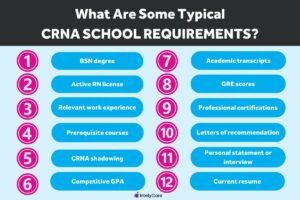
What Are CRNA School Requirements?
Ready to discover the key steps to get admitted into highly specialized nursing programs in nurse anesthesia? Prerequisites can differ from one school to another, but typically involve many of the following requirements:
1. Bachelor of Science in Nursing (BSN) Degree
Begin by earning a nursing degree from an accredited program — either an associate degree in nursing (ADN) or a bachelor of science in nursing (BSN). While many CRNA programs require a BSN for admission, some nurses choose to pursue an ADN degree for faster entry into the field. Then, you can further your education through bridge programs like RN-to-BSN or ADN-to-MSN.
2. Active Registered Nurse (RN) License
The next requirement is a current and unencumbered RN license. This means that the license is active and has not expired. To keep it active, you need to renew your license periodically, typically every one to three years, depending on state regulations. Unencumbered means that the license is clear of any restrictions or disciplinary actions imposed by the state board of nursing.
3. Relevant Work Experience
Many programs require applicants to gain one or two years of hands-on experience in critical care settings, such as the following:
- Surgical intensive care
- Medical intensive care
- Cardiac intensive care
- Neuro intensive care
- Pediatric intensive care
- Neonatal intensive care
- Trauma intensive care
Some schools may also consider experience in other acute care settings as acceptable alternatives. These may include working in emergency rooms (ER), operating rooms (OR), post-anesthesia care units (PACU), or progressive care units (PCU).
Before applying, double-check the types of work experience accepted by your chosen program. Many CRNA programs require it to fall into the critical care category, which is often defined as providing high-acuity nursing care to patients with complex conditions. This includes patients who may need mechanical ventilation, vasoactive infusions, life-sustaining technology, and advanced monitoring.
4. Prerequisite Courses
Remember when you had to complete a list of prerequisites before you could get accepted into nursing school? The same process applies to CRNA school requirements. You may be asked to complete specific classes before starting your program. Although CRNA prerequisites aren’t exactly the same everywhere, many schools expect similar foundational classes. Here are a few you might need:
- Statistics
- Health/physical assessment
- Chemistry
- Inorganic chemistry
- Organic chemistry
- Biochemistry
Keep in mind that some schools set time limits on specific credits. For example, they might require you to finish these prerequisites within five years before applying.
5. CRNA Shadowing Experience
Shadowing experience provides valuable insight into the role and responsibilities of a nurse anesthetist. It allows students to observe CRNAs in various clinical settings, gaining firsthand knowledge of anesthesia procedures and the daily challenges and rewards of the profession.
CRNA programs vary in shadowing hour requirements, typically ranging from 8 to 40 hours. However, some schools might not specify a set number of hours or may not require shadowing at all.
6. Competitive Grade Point Average (GPA)
Generally, CRNA programs seek applicants with strong academic backgrounds. While specific GPA thresholds differ, many programs typically look for a minimum GPA of 3.0 on a 4.0 scale. However, some programs may have higher GPA requirements, such as 3.2 or above.
7. Academic Transcripts
Academic transcripts allow admissions committees to verify whether you have completed the required coursework and attained the necessary academic standards, such as a BSN degree.
This ensures that admitted students have the foundational knowledge and skills needed to succeed in the program.
For U.S.-based candidates, the process is straightforward: Contact the educational institutions where you completed your BSN program and request that they send official transcripts directly to the university you’re applying to. However, if you completed your nursing degree overseas, you’ll need to undergo an academic evaluation through a designated organization, which varies by university. The process may be lengthy, so ensure you plan it in advance.
8. Graduate Record Examination (GRE) Score
The GRE is a standardized test that assesses verbal reasoning, quantitative reasoning, and analytical writing skills. Although not required by all nurse anesthesia programs, some schools still include the GRE as part of their CRNA program requirements. A score of 300 or higher is typically considered competitive for admission.
9. Professionals Certifications
Your CRNA school requirements may include professional certifications, such as:
These certifications not only signify your commitment to patient care but also ensure you possess the necessary skills and knowledge to thrive in a challenging clinical environment.
10. Letters of Recommendation
CRNA programs seek candidates with strong clinical skills and critical thinking abilities. Letters of recommendation provide valuable assessments of your clinical competence and academic abilities. Wondering whom you should ask for letters of recommendation? Here are a few options to explore:
- Clinical nurse leader
- Clinical nurse educator
- Nurse manager
- Nursing preceptor
11. Personal Statement, Essay, and/or Interview
Many programs require you to submit a personal statement or essay outlining your career goals, reasons for pursuing a nurse anesthesia program, and relevant experiences. Additionally, you may be invited for an interview, where you’ll be asked to share about your strengths and weaknesses as a nurse and nursing background, among other questions.
12. Current Resume
Some CRNA programs may require you to submit your nursing resume to gain a comprehensive understanding of your professional history. This provides a chronological overview of your career growth and achievements, helping the admissions committees to determine if you are a good fit for their program.
CRNA School Requirements: FAQ
How long does it take to become a CRNA?
According to the American Association of Nurse Anesthesiology (AANA), CRNA preparation takes at least eight to eight and a half years. This involves meeting all the CRNA school requirements and getting the required experience under your belt.
How hard is it to get into CRNA school?
Getting into CRNA school can be challenging due to the competitive nature of the programs and the rigorous admission requirements. Check your program’s acceptance rate to assess the admission difficulty. Additionally, consider applying to CRNA schools with high acceptance rates for a smoother admission process.
What is a typical CRNA school length?
It usually takes around 36 to 51 months to complete a nurse anesthesia program after meeting the initial CRNA school requirements. During the program, students dive into both classroom learning and hands-on clinical experience. They get to work in different healthcare settings, giving anesthesia under the guidance of CRNAs and anesthesiologists.
What are types of CRNA programs?
CRNA programs are structured to meet the educational needs of nurses at various stages in their careers. Whether you’re entering the field with a bachelor’s degree or already hold a master’s of science in nursing (MSN), there’s a pathway designed for you:
| Program type | Description |
|---|---|
| BSN-to-DNP | This program is intended for RNs who hold a BSN and want to pursue a doctoral degree in nurse anesthesia. |
| MSN-to-DNP | This program is designed for nurses who already have an MSN and wish to earn a doctoral degree. |
Some schools offer online or hybrid formats for the classroom portion of the curriculum. However, it’s important to note that CRNA programs require rigorous clinical training, which must be completed in person at approved healthcare facilities.
How much does a CRNA earn?
Completing CRNA school requirements pays off. The typical CRNA salary in the U.S. is $231,700 a year. However, your earnings can vary based on factors like your experience, work setting, and geographic location. The states with the top salaries for CRNA jobs are:
What is the job outlook for CRNAs?
The Bureau of Labor Statistics (BLS) predicts a 10% surge in job opportunities for nurse anesthetists over the next decade, faster than the average for all occupations. The states with the highest employment levels for nurse anesthetists are:
Can CRNAs work independently?
Yes, CRNAs can work independently — but their scope of practice largely depends on where they practice. However, CRNAs usually operate as part of a surgical team that includes surgeons, surgical techs, scrub nurses, and other healthcare professionals.
What are the best CRNA programs?
According to the U.S. News and World Report, the leading CRNA schools in the country include the following:
- Uniformed Services University of the Health Sciences
- University of Pittsburgh
- University of Iowa
- Baylor College of Medicine
- U.S. Army Graduate Program in Anesthesia Nursing
Find the Best-Fitting Nursing Jobs on IntelyCare
Whether you’re an RN learning about CRNA school requirements or just looking to upgrade your career, we can help. Find out how IntelyCare can provide a personalized nursing job search experience, delivering the latest roles in your area right to your inbox.
Latest Jobs
Error: Failed to parse RSS: String could not be parsed as XML