Using a Nursing Skills Profile When Hiring: 5 Best Practices


Skills profiles help healthcare facility leaders identify the specific competencies required (or preferred) for different nursing roles, which are communicated to job seekers to help match roles with aligned nursing professionals. These profiles can be used in all phases of the nurse hiring process, from writing a job description to making a difficult decision between candidates after the final round of interviews.
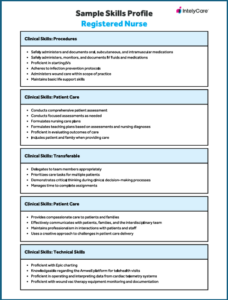
Whether you’re looking into using this strategy for the first time, or bolstering the process you already utilize, you’re in the right place. We’ll cover the best practices for using skills profiling to attract and retain the right nurses for your facility, and provide the following free sample skills list and a template skills profiler tool to give you and your hiring team a head start.
The Purpose of Skill Profiling When Hiring Nurses
Healthcare facility leaders are responsible for hiring new staff members who are not only licensed for the position, but also a great organizational fit. This means that in addition to verifying credentials, hiring managers must consider a wide range of indicators and assess them in terms of compatibility with the vacant position. This involves the use of multiple tools and strategies, including skills profiling.
Skill profiles provide a snapshot of a nurse’s relevant competencies, including clinical skills, soft skills, and transferable skills. Condensing these into a singular view is a practical way to gain an objective understanding of whether an applicant is a good match for a vacant position.
Using Essential Skills Profiles During the Nurse Hiring Process
Skill profiles enter into the hiring process in two distinct capacities: generated by the applicant, and generated by the employer.
When skills are listed by an applicant, the content may appear at the top of a nurse’s resume in a summary, or in a separate section after the work experience or education sections. To recognize content related to a skills profile, CV reviewers may need to look for keywords woven into a resume’s profile statement or work experience. Software can help with this process.
In addition, nursing skill profiles can be generated by hiring facilities, related to the skills needed and preferred for a specific job. This can help a facility to:
- Gain clarity about what they’re looking for in nurse applicants.
- Screen resumes to look for keyword matches.
- Guide the interview process.
- Make decisions between candidates based on alignment with required skills.
Best Practices for Using Skill Profiling in the Nurse Hiring Process
The nursing profession encompasses many different roles and a wide variety of competencies. This can add to the challenge of hiring, because a nurse who is technically qualified still may not possess the particular skills required for successfully performing the job. Using skill profiling during your hiring process is one way to overcome that challenge. Here are five best practices to help you implement or improve this process at your facility.
1. Collaborate to Define the Skills Needed
Work with your unit’s nurse educator, your facility’s human resources department, and unit charge nurses to identify the skills needed for the nursing role you’re working to fill. Consult nursing literature to give your skills list a framework. This process will help you gain clarity regarding what your ideal candidate will look like. Think in terms of pinpointing key or critical skills, rather than creating a comprehensive skills checklist.
2. Include Key Skills in Your Nursing Job Description
Use the skill profile you developed as you write the nursing position job description. Be intentional when describing the desired skill, and use clear, industry-standard language. This language may inform algorithms searching for keyword matches (depending on the tools you use in your hiring process). For example, wound care is standard language in nursing, as opposed to caring for wounds.
3. Use Nursing Skills Profiling to Inform Your Resume Screening Processes
Many healthcare facilities use applicant tracking software (ATS) to screen resumes and filter candidates based on required and preferred criteria. The skills list you created for the vacant nursing position at your facility will guide the parameters you set within your ATS. High-quality nursing job boards provide users with the option of using built-in ATS to screen applicants for you.
4. Incorporate Skills Assessment Into Nurse Candidate Interviews
Automated systems can streamline the hiring process, but in-person interviews are still crucial. When a candidate reaches this point, you’ll likely have information about their clinical skills and other areas of care. However, you may be unsure of their level of proficiency in areas that are harder to assess, such as soft skills.
Keep a nursing position skills profiler handy as you ask the nurse candidate questions, and use the interview as a chance to assess the nurse’s proficiency in the various categories you’ve defined. However, be sure to delineate the absolute requirements of the job from “nice to have” skills and attributes so you don’t discourage qualified candidates. Download our free template, below, to get a head start in creating a skill profile that fits your specific vacancies.
5. Identify Skill Gaps
Delivering excellent patient care is a team activity. Defining the skill profiles for individual positions on the team can help you discover what your unit is missing. Once this gap is identified, leverage the resources available to you to complete your nursing team.
This might involve working with a staffing partner to fill positions with nurses who possess the missing competencies or maximizing the reach of your job post through an online platform with ample traffic.
Need Help Matching With a Qualified Nurse?
Learning how to use essential skills profiles during the nurse hiring process is a great step toward meeting your staffing goals. Need help attracting high-quality candidates quickly? Consider posting your open position to our network of over a million qualified nurses who are actively seeking work.