The Future of Travel Nursing: Trends and Predictions (2026)



Contracting travel nurses is no longer merely a strategy for surviving an acute staffing crisis, as it was decades ago. The use of travel nurses across American healthcare settings is now considered a standard, year-round approach to safe staffing, and the future of travel nursing promises to be influenced by the same demographic shifts affecting many other segments of the healthcare workforce.
Unprecedented demand for nursing professionals during the pandemic created a spike in the use of travelers beyond the already expansive need for nursing professionals. However, as the world approaches the post-pandemic decade mark (and given the current healthcare landscape), what is the future of travel nursing? This article will explore answers to that question by examining healthcare staffing trends and insights into how travelers may fit into your future staffing strategies.
Equipped with an expert-backed forecast, you can better ensure appropriate patient coverage and the highest quality care over the next 5 to 10 years, and beyond.
Snapshot of Travel Nursing’s Past
Travel nursing, defined as contracted nurses taking on temporary assignments outside their home areas, can be traced back to New Orleans in 1978, when nurses relocated to fill a Mardi Gras season staffing crisis. The strategy gained prevalence during the nationwide nursing shortage of the 1980s, as travel nursing agencies connected nurses with hospitals and clinics in dire need of clinicians.
In the 1990s travel nurses were often utilized to cover for nurses on maternity leave, giving rise to the 13-week assignment (a standard duration for maternity leave). By the early 2000s over half of the hospitals in the U.S. were using travel nurses, not only as a way to get through a crisis or acute staffing need, but as a permanent piece of the staffing puzzle.
Is Travel Nursing Going Away?
Travel nurse industry trends show a pronounced surge during the pandemic years (March 2020 – May 2023), due to an unprecedented exodus of 1.6 million healthcare workers from the workforce between February and April of 2020. With so many clinicians unavailable, facilities had to rely heavily on travel nurses and per diem staff to meet the unprecedented patient demands. So, while travel nurses accounted for about 4% of total nurse labor expenses pre-pandemic, this figure grew to almost 40% near the end of the pandemic.
After the exponential growth of travel nursing utilization, the post-pandemic years were marked by a scaling back in its use. Indeed, the past three years have witnessed a steady travel nurse revenue decline, raising the question, Is travel nursing going away?
The short answer is no. The market is stabilizing, and travel nursing remains crucial to the healthcare system, so much so that 2026 is projected to see a 1% increase in travel nursing revenue. Let’s look at the policies, demographics, and industry trends that predict the continued (and growing) demand for travel nurses across America.
3 Key Trends Shaping the Future of Travel Nursing: 2026 and Beyond
Effective, sustainable nurse staffing requires an alignment of resources with patient needs to provide safe and productive patient care. It often involves employing a mix of per diem, full time, and part time employees. Within that make up, travel nursing remains a crucial resource for facilities looking to meet modern patient demand. As that need grows, travel nursing future utilization may be influenced by the following three trends:
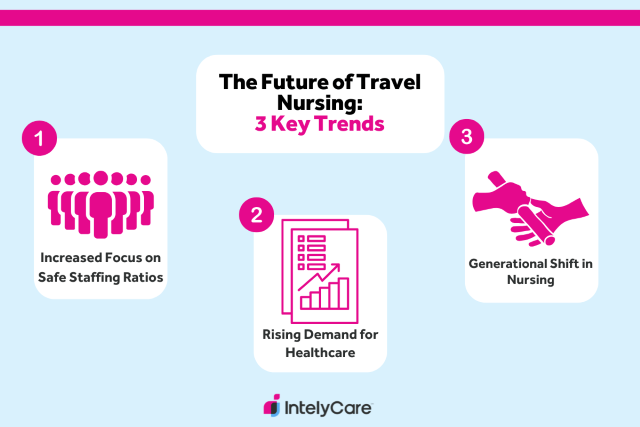
1. Increased Focus on Safe Staffing Ratios
A growing body of research consistently shows that adequate staffing levels are closely linked to positive patient outcomes. California’s nurse-patient ratio law has been linked to decreased hospital acquired infections (HAIs), reduced readmission rates, and improved patient satisfaction scores.
While Massachusetts and Oregon also passed nurse-patient ratio laws, other states (such as Nevada, New York, and Ohio) require facilities to have staffing committees. More states are considering laws and regulations to promote safe staffing ratios and, as of mid-2025, federal legislation for mandated staffing ratios has been introduced by Congress.
Prediction: The increased focus on safe staffing (and potentially additional legislative activity) will lead to sustained travel nurse demand as facility leaders work to stay compliant and provide optimal patient care.
2. Rising Demands for Healthcare
The U.S. population is aging, due in part to a longer life expectancy, resulting in increasing demands for healthcare. The fastest growing segment of the population consists of individuals who are 85 and older. Older adults account for a disproportionately large share of healthcare utilization due to the accumulation of chronic conditions, increased rates of comorbidities, and functional limitations.
This trend will continue, with 2030 marking the year that all baby boomers are over age 65, meaning that 1 out of every 5 Americans is an older adult. By 2034 there will be more older adults than children in the U.S. for the first time in history.
Prediction: As the aging population puts increasing demands on the healthcare system and intensifies the nationwide nursing shortage, demand for quality nursing care will grow. This trend may create more opportunities for temporary assignments and lead to increasingly competitive offers within the future of travel nursing pay.
3. Generational Shift in the Nursing Workforce
As baby boomers retire, millennials and Gen Z nurses are becoming a larger portion of the nursing workforce alongside Gen X. This means that facility leaders and managers can expect some staff to have distinctly different values and priorities than nurses from older generations. Gen Z nurses (moreso than millennials or Gen Xers) may see flexibility as a nonnegotiable, and prioritize nonstandard schedules and time commitments as their peers also favor similar occupations to a travel nurse to escape rigid employment logistics.
These nurses may not sign up for permanent positions, but instead favor per diem, temporary assignments, or travel nurse assignments that allow them to work when and where they want. Their preference for flexible or remote work decreases the number of permanent and full time staff and increases the travel nursing demand.
Prediction: Leading up to 2030, facility managers can expect to see a shift in the values of staff members. While millennial nurses may accept travel nurse assignments based on opportunities for learning and development, Gen Z nurses might make assignment decisions based on the perception of control it affords their future, encouraging nurse recruiting that highlights opportunities for enhanced work-life flexibility.
Solve Your Staffing Needs With Qualified Nursing Professionals
The future of travel nursing (pay, schedules, utilization rates, and beyond) will reflect changes in the healthcare industry, such as increased focus on safe staffing. Meet your modern staffing goals with ease using the right nurse staffing solution so you can continue to deliver stress-free, high-quality patient care.