Preventing Medication Errors in Nursing: 5 Best Practices



There are many steps involved in the safe administration of medications in healthcare, and nurses are one of the last lines of defense. With the proper education, training, and resources, nurses safely administer medications to patients as part of their treatment plans. However, medication errors in nursing (among other roles involved in the administration of drugs) still occur. It’s actually one of the most common types of medical errors.
A medication error (also called med errors in nursing lingo) can result in a near-miss, patient harm, or a sentinel event. The consequences are costly — totaling an estimated $40 billion annually for the healthcare industry. As a facility leader, there are steps you can take to cultivate a culture of safety to protect patients and maintain their trust. We’ll cover those in addition to the realities of nursing medication errors and some key best practices for preventing them.
What Constitutes a Medication Error?
The Agency for Healthcare Research and Quality (AHRQ) describes two potentially harmful events that can occur during medication administration: medication errors and adverse drug events (ADEs).
Medication Error
This is any error at any juncture of the medication administration pathway. The process follows a chain of events from the time a drug is prescribed, prepared, and administered. Various healthcare disciplines are involved, such as providers, pharmacists, pharmacy techs, and nurses. A series of checks and balances occurs throughout the medication administration pathway. A breakdown in the process may result in a medication error.
Example: A physician writes a STAT order for potassium chloride for a patient on a telemetry unit. The bedside nurse understands the patient needs the infusion urgently due to cardiac rhythm changes. The nurse overrides potassium and administers it before it’s verified by a pharmacist. After the infusion is started, the nurse realizes the wrong dose was given.
Adverse Drug Event (ADE)
Even when medications are administered correctly, a patient may experience an unanticipated reaction after drug exposure, resulting in patient harm. This is known as an adverse drug event (ADE). Many ADEs occur outside of the healthcare setting and may result in hospitalization. An estimated 5 to 10% of patients experience an ADE, making it one of the most common types of medication errors in the inpatient setting.
Example: A patient with no known drug allergies is given IV contrast for a CT scan. Shortly after the injection, the patient has an anaphylactic reaction and stops breathing. The patient has to be emergently intubated and the CT scan is delayed. While there was no preventable medication error, the patient’s reaction to the drug resulted in an adverse event.
How to Prevent Medication Errors: Nursing Team’s Role
There are many potential causes of medication errors in nursing, from the demands of a high-acuity patient population to the workloads placed on nursing staff. Within the core competencies of nursing, the Quality and Safety domain states nurses should articulate their role within an interdisciplinary team in promoting safety and preventing errors and near misses. To do this, nurses must follow the five rights of medication administration when giving drugs:
- Right person
- Right drug
- Right dose
- Right route
- Right time
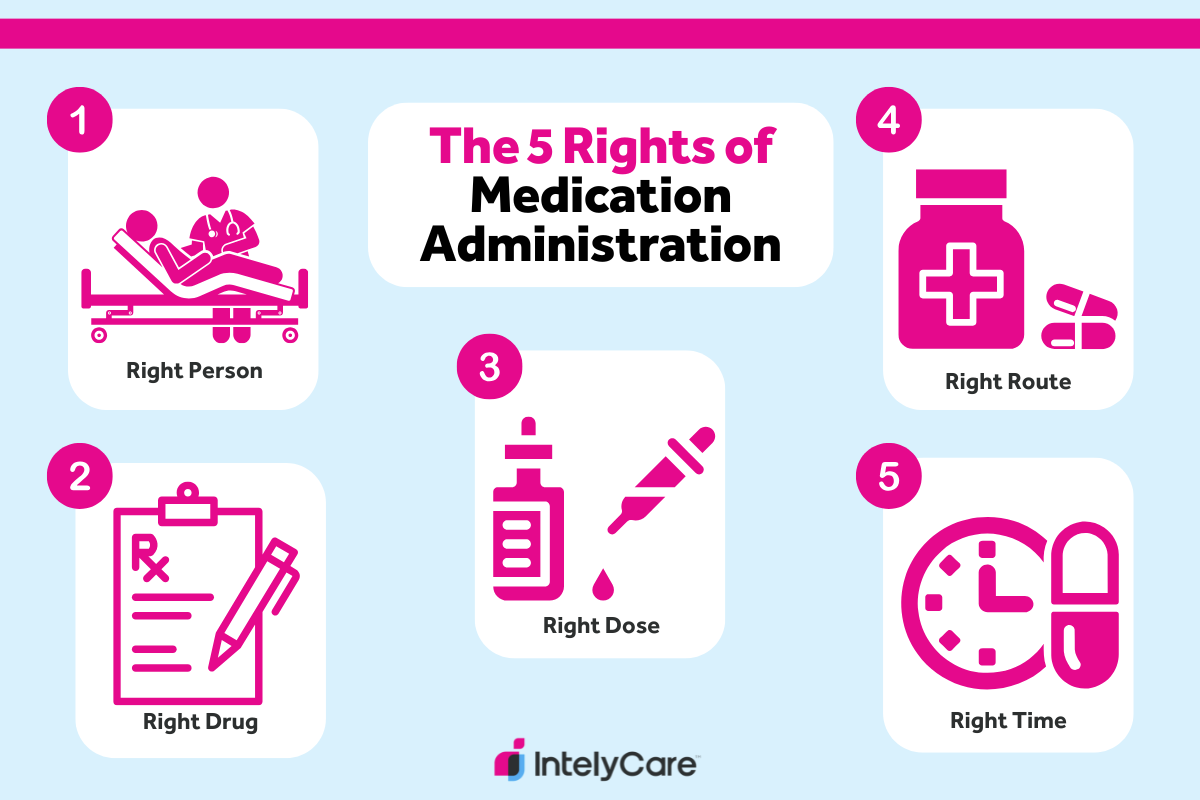
Over time, extra “rights” have been added to the core five, with some advocating for as many as four more, including:
- Right documentation
- Right action/reason
- Right form
- Right response
It’s a good idea to specify in your facility’s policy which “rights” your staff should use, and : to shape your medication administration protocols. Checking the standard five rights, at minimum, is one of the most fundamental ways to prevent medication errors in nursing. Nurses must also use clinical judgment to consider allergies, liver or kidney risk factors, or other factors like expired drugs, to prevent harm. Below is an example of using clinical judgment to prevent harm.
Example: A nurse has an order for vancomycin on a patient with acute kidney injury. Before administering the dose, the nurse asks the provider to order a vancomycin trough to check their drug level, confirming the “right dose” and “right time.” The trough is high, and the vancomycin is not administered and rescheduled for another day, preventing further kidney damage.
Preventing Drug Errors in Nursing and Beyond: 5 Tips
There’s no one-size-fits-all solution to reducing medication errors in healthcare. Safety with medication administration (for nurses and the rest of the interdisciplinary team) depends on collaboration and verification systems along the medication administration pathway. The Joint Commission’s national patient safety goals for medication administration include the following recommendations:
- Improve the safety of using medications.
- Maintain and communicate accurate patient information.
- Reduce harm related to anticoagulant therapy.
- Label all medications and containers in perioperative settings.
Below are five practical ways to meet medication safety goals to ensure patient safety at your facility.
1. Leverage Technology for Medication Safety Checks
Some cases of medication errors by nurses are driven by risky, outdated processes. Once a common practice, handwritten prescriptions that were easy to improperly transcribe are now a thing of the past thanks to updated technology like computerized physician order entry (CPOE). Your healthcare organization may use an electronic medication administration (eMAR) system to facilitate better order transcription and safe medication administration. Leveraging the eMAR to its fullest potential is an excellent method for preventing med errors.
When investing in additional healthcare technology, select a package that includes safety features that optimize the medication review process. With the help of predictive analytics, an eMAR system can provide warnings related to:
- Allergies
- Adverse reactions
- High-alert medications
- Improperly high doses
- Drug interactions
Technology can also be used to streamline the medication reconciliation process during care transitions. This helps evaluate a patient’s risk for an ADE and can be a useful way to prevent medication errors in nursing homes and long-term care facilities.
2. Use a Barcode Scanning System
Barcode medication administration involves scanning a patient’s wristband and medication packaging prior to drug delivery. This is a crucial step of the process that supports the five rights of medication administration. If your healthcare facility already implements this technology, ensure nurses have the tools and resources to be compliant with barcode technology, such as:
- Functioning workstations on wheels (WOW).
- Fully operating barcode scanner devices for every WOW.
- Clear policies and procedures about barcode use.
Another way to ensure effective barcode scanning is to perform periodic scanning audits. This helps identify instances that jeopardize medication errors in nursing. Examples of shortcuts that may lead to problems include bypassing scanning requirements due to issues like technology delays (or even faulty barcodes) that interfere with the process.
3. Have a System for High-Alert Drugs
Look-alike-sound-alike drugs and high-alert medications can increase the risk of medication errors or ADEs. The Joint Commission recommends the following strategies to prevent medication errors related to look-alike-sound-alike drugs:
- Use the brand and generic name on medication labels.
- Include the purpose of the medication on labels.
- Configure computer systems to include the first five letters of a drug name in searches.
- Change the appearance of look-alike-sound-alike drugs.
When administering high-alert medications, nurses should follow a system for double-checking doses with another licensed professional. Healthcare leaders must ensure nurses have policies to follow for verifying high-risk drugs. Technology can be integrated into the eMAR requiring a second signature prior to administration of high-alert medications, such as:
- Anticoagulants
- Narcotics
- Antiarrhythmics
- Moderate sedation
- Chemotherapy
- Total parenteral nutrition (TPN)
4. Reduce Distractions
Healthcare environments are often associated with high levels of stress — but added chaos from heavy clinical loads can contribute to medication errors in nursing. Statistics show the most common reason medication errors occur is distraction, accounting for 75% of errors.
Healthcare facility leaders should examine the number of distractions that occur on a given nursing shift that may interrupt medication administration. Are nurses responsible for answering call bells due to an unlicensed assistive personnel shortage? Discover the underlying issues causing unsafe environments for medication administration and begin addressing them.
5. Create a Just Culture
A critical component of prevention is a standard incident reporting system for medication errors, and nurses should feel comfortable throughout the process. This encourages authentic reporting, lending real and usable data that allows other healthcare team members (such as those in a risk-management department), to review the cause and find solutions for preventing errors in the future.
Reporting medication errors in nursing should be seen as a learning opportunity instead of a cause for punishment. This concept, known as just culture in healthcare, establishes a blame-free atmosphere that considers the conditions and behaviors that may contribute to mistakes. By creating a just culture environment, leaders create a collaborative healthcare environment that allows the team to learn from mistakes and work toward change together.
Learn More Ways to Improve Outcomes at Your Facility
It’s up to the entire healthcare team to reduce medication errors in nursing. Consequences are often the burden of patients — don’t let that happen at your facility. Protect your patients with IntelyCare’s wide range of facility guides and best practice recommendations and ensure safer, quality care.