What to Expect at a White Coat Ceremony for Nurses


The white coat ceremony for nurses — often called an oath ceremony — is a meaningful academic tradition that marks the start of a student’s journey into the nursing profession. With cameras flashing and loved ones cheering, each nursing student receives a crisp white coat and recites a professional oath — symbolizing their commitment to ethical and compassionate patient care. Beyond the coat itself, the ceremony gives an opportunity to reflect on what it really means to be a professional nurse.
But what is a white coat ceremony supposed to symbolize? And what exactly happens during the white coat nursing ceremony? From formal speeches to the symbolic robing, this article is your complete guide to what to expect on this unforgettable day.
What Is a White Coat Ceremony for Nurses?
A white coat ceremony is a formal, symbolic event that marks a nursing student’s step into professional practice. During the ceremony, nursing students are presented with their first white coat by faculty members, signifying their entry into the healthcare profession and their commitment to patient care.
Many schools hold these ceremonies when students first start their nursing programs, but some celebrate them later in the curriculum. As the tradition has grown to hundreds of schools, each school has found ways to make the ceremony feel unique and meaningful, reflecting its own values and approach to nursing education.
Here are the key moments that happen during the ceremony:
- Receiving the white coat: Nursing students are formally presented with their first white coat — usually by faculty or nursing program leadership team.
- Reciting a pledge or oath: Many ceremonies include a pledge to uphold core nursing ethical principles, such as accountability, justice, nonmaleficence, and fidelity. In some programs, students recite the Nightingale pledge, a historic oath that emphasizes dedication to patient care.
- Formal speeches: Faculty, deans, or experienced nurses often deliver remarks to welcome students into the profession and set expectations for their educational journey and future responsibilities.
- Celebration and recognition: The ceremony is usually attended by peers, family, and friends, making it both a professional milestone and a personal celebration. It honors students’ hard work, dedication, and achievements — because getting into nursing school is no small feat — while also acknowledging the important responsibilities they are taking on as future nurses.
History of the White Coat Ceremony
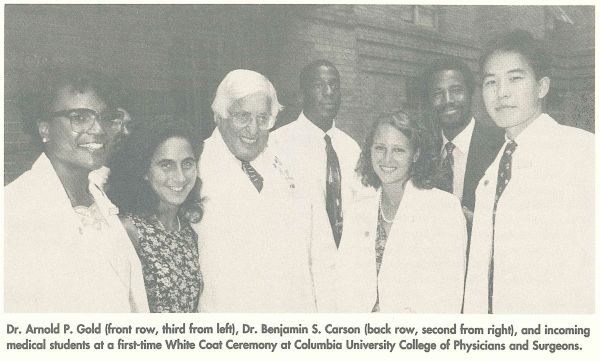
The white coat ceremony was started by Arnold P. Gold Foundation (APGF). Its first official full‑fledged ceremony was held in 1993 at Columbia University Vagelos College of Physicians and Surgeons, under the guidance of Arnold P. Gold, a world-renowned pediatric neurologist.
Dr. Gold — and the Foundation — believed that students should pledge to uphold essential ethics at the very start of their studies and not wait until graduation to do so (as is tradition with the Hippocratic Oath). For years, he watched medical students recite the oath on their graduation day and would shake his head at his wife and co-founder, Sandra Gold. “It’s too late,” he would say. “They are already the physicians they will be.”
That’s how the white coat ceremony came to be a rite of passage and a promise. It’s a moment where students put on more than just a white coat; they’re stepping into a commitment to care for patients with empathy, respect, and integrity.
In 2014, the APGF partnered with the American Association of Colleges of Nursing (AACN) to introduce the ceremony to nursing programs, highlighting the essential role nurses play in patient care.
The first pilot programs began at roughly 100 nursing schools nationwide. Over time, hundreds more adopted the ritual, making the white coat ceremony for nursing students a widespread tradition across the U.S. As of the mid‑2020s, more than 450 nursing schools have participated in Gold‑AACN white coat ceremonies.
White Coat Ceremony for Nurses: FAQ
Who gets a white coat ceremony?
The white coat ceremony is not limited to nursing or medical students — it’s a tradition that has expanded to include students across a wide range of healthcare professions. Here are some examples of professionals who may participate in these ceremonies:
- Registered nurses (RNs)
- Licensed practical nurses (LPNs)
- Medical students (MDs, DOs)
- Dental students
- Pharmacy students
- Physician assistants (PAs)
- Physical therapy and occupational therapy students
- Other allied health professionals, such as respiratory therapists, nutritionists, or audiologists, depending on the school
Do LPNs get a white coat ceremony?
Though white coat ceremonies are not new in the health professions, they are relatively recent in nursing education.
Whether an LPN student participates in a white coat ceremony depends largely on the school and program. Some nursing programs include LPNs, particularly if they are part of an LPN-to-RN bridge program, while other schools may reserve the ceremony for Bachelor of Science in Nursing (BSN) and graduate students.
Does a white coat ceremony mean you graduated?
No — a white coat ceremony does not mean a student has graduated. In most programs, the ceremony takes place at the start of a program, symbolizing a student’s entry into the profession. It is separate from school graduation or pinning ceremonies, which occur at the completion of a program and officially mark the student’s transition into the workforce.
With that being said, some nursing schools may hold the ceremony later in the program, such as just before students begin clinical rotations or at other key milestones. Even in these cases, the white coat still symbolizes a commitment to professional values — not program graduation.
Are You a Nursing Student Looking for a Job?
Excited about your upcoming white coat ceremony? While you focus on your studies, we can help you find quality nursing jobs that fit your schedule and career goals. Sign up for personalized alerts and be the first one to know when opportunities you want open up.