What Is a Nurse Informaticist? A Day in the Life


In This Article |
|---|
|
What is a nurse informaticist? In 1992, the American Nurses Association (ANA) officially recognized informatics as a new specialty, and the scope of this role has expanded and evolved since then. Nursing informatics combines data science with nursing expertise. These specialists use evidence-based innovations to improve patient care and support nursing practice. The ANA specifically notes that the role of these nurses is to use technology in order to “manage and communicate data, information, knowledge, and wisdom” — what is known as the DIKW pyramid.
Medical informatics is a broad data science field that combines pharmacy, biomedical science, and public health. Nursing informatics applies data specifically to the field of nursing and the ways that nurses can improve patient outcomes through ongoing systems-level innovations.
What is nursing informatics? The role includes these three competencies:
- Computer skills: Conducting searches for information, retrieving patient data, and using information technologies to improve care.
- Informatics knowledge: Understanding the value of nursing data, ethical considerations in computer systems, and clinician involvement in healthcare systems design.
- Informatics skills: Interpreting information flow, developing standards, and conducting research and data analysis.
If you’re interested in data analytics and you’re looking for a corporate nursing career or a non-bedside role, health informatics might be a great path for you. Informaticists work for health tech companies, hospitals, public health groups, and more, using their expertise to guide systems improvements. Let’s explore what else a nurse informaticist is responsible for, and what you might expect from this career.
A Day in the Life: What Does a Nurse Informaticist Do?
Nurses in this role generally don’t work with patients. Instead, they spend their workdays gathering and analyzing data to understand clinical problems at the system level. They also act as resources when staff need education and support, and are constantly aiming to improve the safety and quality of healthcare.
Here are three main types of responsibilities a nurse informaticist might have, as well as examples for each:
1. Work on Timely Projects: These types of projects involve several members of the healthcare team, as informaticists help implement new changes to technology systems. Tasks might include:
- Update documentation protocols in the electronic medical record (EMR) at a large hospital.
- Introduce new remote monitoring tools within a home health agency.
- Develop a new scanning system for laboratory staff to shorten response times.
- Analyze outcomes of a previous tech rollout to improve how future systems are implemented.
2. Educate Team Members: Orienting and educating staff on systems changes. Examples of education-type duties include:
- Rotate to units throughout the hospital as a new EMR system is rolled out.
- Become a superuser, or resident expert, in a new glucose monitoring tool, so they can educate staff on troubleshooting.
- Hold in-service sessions to show an improved way to document pressure ulcer screenings.
- Give a presentation to corporate leadership about how a new workflow is improving turnaround time in the OR.
3. Support Other Departments: Helping patient-facing staff integrate changes into their processes. A nurse informaticist might be required to assist in the following:
- Help staff make informed decisions about alerts that auto-populate on the medication administration record (MAR).
- Troubleshoot when a physician needs help navigating a new patient portal.
- Support the patient registration team as they implement a new billing software.
- Communicate with tech system vendors when issues arise.
How Do Nurse Informaticists Interact With Other Professionals?
As part of your daily duties as a nurse informaticist, you’ll work with every member of the healthcare team to help them understand and use new technology. You could be educating a physician on how to use a new order set in the morning, and then working with a division manager to pull data on patient discharges in the afternoon.
Informaticists might communicate with corporate leadership, laboratory staff, operating room management, and respiratory therapy, all in one day. Every role in healthcare uses technology, and nurse informaticists are essential for supporting team members in systems changes.
Essential Skills of a Nurse Informaticist
Could you thrive in this role? Qualities that could make you a great informatics nurse include the following:
- Patience: Informatics nurses may need to teach other clinicians about new software, updates, or documentation changes. This will likely require educating or troubleshooting on the same system repeatedly.
- Tech savviness: If you have a natural affinity for electronic health records (EHR), computers, and data, you might do well in this role. A great informaticist is comfortable learning new tech and adapts to constant updates.
- Communication: Nurse informaticists communicate with their team members, as well as patient-facing clinicians, hospital leadership, the IT team, and much more. As in most nursing roles, being a people person will make the job easier.
- Systems thinking: A nurse informaticist needs to be able to consider multiple angles of a problem and use critical thinking to solve issues at the systems level.
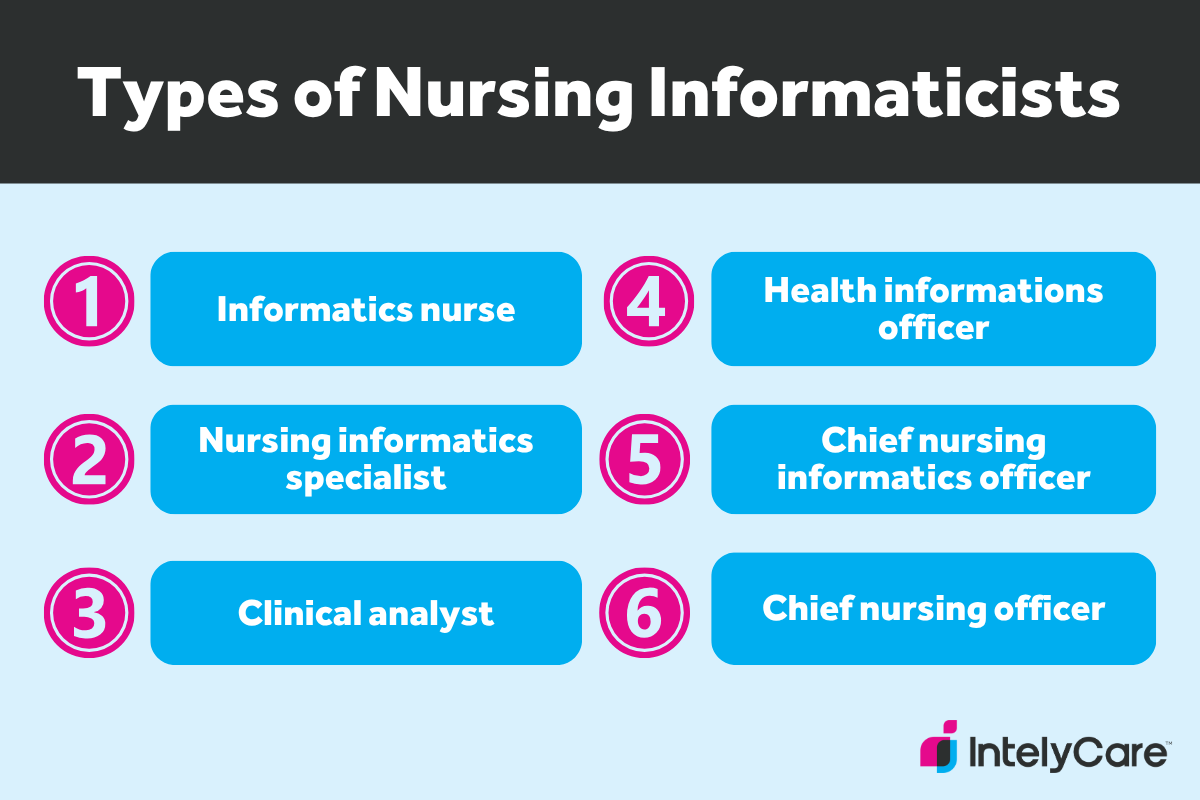
Roles Available for Nursing Informaticists
Nursing informatics careers can include a range of roles within healthcare systems and private companies. What is a nurse informaticist job title? An informatics nurse may go by these titles and work as any of these types of informatics nurses:
- Informatics nurse
- Nursing informatics specialist
- Clinical analyst
- Health informations officer
- Chief nursing informatics officer
- Chief nursing officer
Nurse Informaticist Salary and Career Outlook
How much does a nurse informaticist make? The average annual salary for an informaticist is around $110,000. Your salary will depend on the area you work, your experience, and your certifications. For example, you could earn more by becoming board-certified as a nurse informaticist (NI-BC).
The job outlook for medical information technologists is bright, with the Bureau of Labor Statistics projecting a 15% growth in jobs in the next several years. At the same time, the demand for RNs is expected to grow by 5%, also faster than average. Becoming a nurse informaticist could be a great choice if you’re seeking a stable and rewarding career.
Nurse Informatics FAQ
What is a nurse informaticist vs. an IT nurse?
An IT nurse, or a nurse that works in the IT department, helps the clinical team by troubleshooting technology, managing systems, and providing day-to-day support. A nurse informaticist tends to serve as a clinical liaison in systems development, data analysis, and more. Informatics roles include less daily tech management and troubleshooting and more systems development and improvements.
Do nurse informaticists work from home?
It depends on the role and their focus. Since they work in online systems, you might think that every informaticist can work remotely, but this is not necessarily the case. The role also tends to involve hands-on teaching, which is typically done in person. Plus, many informaticists work on-call shifts and see multiple units or departments in a day. See job descriptions for specific details, and check out more remote nursing jobs.
Is nursing informatics stressful?
It can be. The role requires balancing the needs of patients and staff, as well as budgetary restrictions and leadership. You might work on tight deadlines or have to respond to system problems quickly to avoid interruptions in patient care. Just because it’s not a clinical nursing role doesn’t mean it’s not challenging.
Do nurse informaticists do a lot of math?
It depends on the role, but in general, these professionals need a strong understanding of data analysis alongside coding and programming. While some roles don’t require as much calculating, you’ll need to have strong basic math skills for this role.
How to Become a Nurse Informaticist: 5 Steps
To become a nurse informaticist, you’ll need to first become a registered nurse, and then get additional education and specialized skills. Here are the five steps to follow:
Step 1: Go to Nursing School
The journey to becoming a nurse informaticist typically begins with earning a Bachelor of Science in Nursing (BSN) degree. You might also start with an Associate Degree in Nursing (ADN) and go back for your BSN or into an accelerated ADN-MSN program.
During nursing school, you’ll gain knowledge that’s fundamental to clinical nursing and informatics. You’ll take classes on research, public health, ethics, specific specialties, and more. These classes lay the groundwork for your future role in nursing informatics.
Step 2: Pass the NCLEX-RN
After graduation, you’ll need to take the National Council Licensure Examination for RNs (NCLEX-RN). Passing this standardized test will make you a registered nurse. This test includes questions on clinical judgment, so you’ll want to thoroughly prepare before taking it.
Step 3: Gain Clinical Experience
Most companies that hire nurse informaticists want to see clinical experience. This foundation of patient care will help you understand the ways that your work as an informaticist impacts clinicians and patients. Many new graduate nurses choose to go directly into acute care, because it’s a great place to build skills and critical thinking.
Once you’re working, there are a few ways you can strengthen your resume and skill set in informatics. If a new software or EHR technology is being optimized or introduced to your unit, volunteer to be a superuser or assist with a new system rollout. You might do a quality improvement project using data you gather from your EHR. Pursuing further certifications could help your career as well.
Step 4: Earn Your Master’s
A Master of Science in Nursing (MSN) is the next step to becoming a nurse informatics specialist. Most MSN programs are flexible, and many are online, so you may choose to continue working while going back to school. In these programs, you’ll take classes like these:
- Foundations in nursing informatics
- Basic statistics for nursing and nursing services management
- Theoretical and conceptual foundations in nursing
- Clinical research
- Financing health care
- Health database systems
Schools also typically require practical experience alongside the courses above, somewhat like clinical rotations during your prelicensure program.
Step 5: Get Your Nurse Informaticist Certification
Nursing informatics is constantly evolving as technology advances, and innovations like AI in medicine shift the way that care is delivered. Continuing education certifications and courses can help set you apart as an informaticist, growing your expertise and your salary.
Here are three of the leading certifications currently available to nurse informaticists, and the requirements you’ll need to meet for each:
ANCC Informatics Nurse Certification (NI-BC): This is offered by the American Nurses Credentialing Center. You must be a BSN-prepared nurse with at least two years of experience, have completed 30 hours of continuing competency in informatics in the past three years, and meet one of these practice requirements:
- Completed at least 2,000 of informatics nursing practice in the past 3 years
- Practiced at least 1,000 hours of informatics nursing in the past 3 years, and completed at least 12 hours of academic credit in informatics courses at the graduate level
- Completed a graduate program in informatics with a minimum of 200 hours of faculty-supervised practicum in informatics nursing
Healthcare Information and Management Systems Society (HIMSS) Certifications: These are not specific to nurses, but HIMSS is a leading organization in healthcare IT education. You’ll need to take a certification exam to become certified. They have several different certifications whether you’re a new or experience nurse informaticist:
- Certified Associate in Healthcare Information and Management Systems (CAHIMS)
- Certification Professional in Healthcare Information and Management Systems (CPHIMS)
- Certified Professional in Digital Health Transformation Strategy (CPDHTS)
Project Management Certifications: Hiring managers love to see applicants who can build and manage plans for implementing technology. As a nurse informaticist, project management certifications can build your leadership skill set, and increase your competitive advantage in nursing informatics. For example:
- Lean project management maximizes value while keeping waste to a minimum.
- Six Sigma project management aims to improve processes, minimize waste, and increase customer satisfaction.
Check Out Fresh Opportunities Across Nursing Specialties
Now that you can answer the question, What is a nurse informaticist, you might also be curious about other specialty nursing roles. Sign up for nursing job notifications to get updates on new opportunities in your area.