Registered Nurse Performance Evaluation: Template and Tips


Healthcare is an evolving field that requires facilities to employ continuous quality improvement measures to stay current. For many on the frontlines, the registered nurse performance evaluation is the best opportunity to review quality standards and learn about updates to best practices.
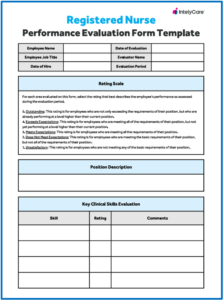
Often considered scary — or, simply one more administrative hoop to jump through — a well-done performance evaluation can have tremendous impact on morale and institutional viability. We’ll explain how evaluations can be a driver for change among your RN staff — complete with this downloadable, customizable performance evaluation template for your convenience.
Registered Nurse Performance Evaluation Process
Registered nurses are busy enough that they may rarely find the time for self-reflection, but studies show that such introspection boosts professionalism and improves communication skills. A quality RN performance evaluation process provides that opportunity for reflection, reinvigorating professional engagement.
Using a templated form for your evaluations can keep the meeting productive — especially given the frequent hesitance to offer truly constructive feedback for fear of hurt feelings. Over time, this sort of avoidance can lead to significant problems, even jeopardizing patient safety if the performance issues — such as poor clinical judgment — persist. A standardized, templated evaluation process ensures that meetings are fair, supportive, and effective.
Be sure to provide the form ahead of time. Preparation is essential for nurse self-evaluation — examples of both similar and different perceptions of the evaluated RN and leadership may help direct better, targeted goals. Additionally, it allows plenty of time to craft meaningful registered nurse performance evaluation comments that are specific to competency expectations for an RN.
The Me, You, Us RN Performance Evaluation Form-Driven Approach
You might also consider using this three-pronged approach, which helps ensure that everyone is on the same page and working toward the same goals. In this model, me represents the RN, you represents leadership, and us is the collaborative relationship between the employee and the organization. Here’s a breakdown.
Me: Self-Assessment
This portion of the RN performance evaluation focuses on the nurse’s self-assessment of their skills and fulfillment of the organization’s registered nurse job description expectations. Provide a thorough, templated job description and competencies checklist. Ask the RN to provide examples that showcase their skills, knowledge, and professional behaviors.
Considerations:
Ask how the RN individualizes patient care to build trust and rapport with patients. The nurse should speak to their nursing process, using this opportunity to reflect on best practices.
You: Management’s Assessment
Nursing leadership now has the chance to speak to their assessment of the employee’s role duties and expectations fulfillment. Complete the form in advance to prevent last minute changes that soften intended feedback. Celebrate any convergence of the two (me, you) assessments as communication wins between the employee and the organization.
Considerations:
Management should have gathered peer feedback to contribute to the evaluation process. Now’s the time to address a nurse’s interprofessional collaboration, proficiency, and teamwork.
Us: Collaborative Goals
Here’s where the process becomes definitively collaborative. Giving special consideration to those feedback areas where evaluation metrics diverged, revise and agree on mutually beneficial goals and plans for progress. Assess pre-developed goals for common intentions. Use a blended version as the final objective. Then make the action plan a collaborative effort — encouraging RN feedback for how leadership can support constructive growth.
Considerations:
If a nurse is routinely struggling with task management in their caseloads, better efficiency needs to be a goal. Work together to identify methods of task prioritization, whether it be through participating in a mentoring program or engaging in additional training on delegation.
Documenting Your Registered Nurse Performance Evaluation: Examples and Tips
The best form for optimizing your registered nurse evaluations breaks the process down into easy-to-follow sections. Templated forms should always include:
- Identifying information
- Rating data
- Skills evaluation
- Goal setting
Below, we’ll examine how to make each of these performance evaluation aspects specific to your registered nursing staff.
1. Identifying Information
Safe and efficient care depends on good medical record keeping, so it should come as no surprise that the business side of healthcare also benefits from high-caliber documentation. Reinforce this standard by starting the evaluation with all the necessary organizational and employee information for anyone later looking to cross-reference or track performance-related progress.
Suggestions:
- Use this seemingly generic portion of the template to review a nurse’s HIPAA compliance and patient confidentiality standards in the workplace. This is a good opportunity to update your registered nursing staff about policy changes regarding social media or unit-level patient privacy measures.
- Before filing, comb RN performance evaluation examples for peer information and remove personal identifiers of non-participants, substituting for generic references and pronouns instead.
Example:
| Employee Name | Taylor Smith | Date of Evaluation | 06/01/20xx |
| Date of Hire | 01/01/20xx | Evaluator Name | Carmen Rodriguez |
| Employee Job Title | Registered Nurse | Evaluation Period | 01/01/xx-05/31/xx |
2. Rating Data
To help ease a process that many associate with tension and conflict, ensure equity and impartiality by developing and including a preset rating standard into the evaluation form. Go over this standardized scoring scale with RNs during their evaluation to underscore the importance of a just workplace culture. This time is also an opportunity for feedback about the organization’s inclusivity and the nurse’s provision of culturally competent care.
Suggestions:
- Have human resources (HR) review the rating tool and information for compliance and transparency before final implementation as part of the nursing performance evaluation.
- Provide succinct, straightforward definitions for each metric or rating scale component and clarify that there’s always space for comments. A skill scoring metric is useful as quantified data, but qualifying information about a nurse’s specific approach — whether it’s value-based or guided by a particular theory — will reinforce the scoring decision.
Example:
| 5. Outstanding | This rating is for employees who are not only exceeding the requirements of their position, but who are already performing at a level higher than their current position. |
| 4. Exceeds Expectations | This rating is for employees who are exceeding the requirements of their position, but not yet performing at a level higher than their current position. |
| 3. Meets Expectations | This rating is for employees who are meeting all of the requirements of their position. |
| 2. Does Not Meet Expectations | This is for employees who are meeting the basic requirements of their position, but not all of the requirements of their position. |
| 1. Unsatisfactory | This is for employees who are not meeting any of the basic requirements of their position. |
3. Skills Evaluation
Registered nurse performance evaluation questions need to be specific because patient safety relies on the ability to perform specialized assessments and interventions. Because RNs work across so many departments and fields, it’s important that the registered nurse performance evaluation sample skills are pertinent to the nurse’s clinical area or specialty.
Suggestions:
- Interview unit champions or your quality improvement nursing committee for assistance when selecting the top skills necessary for effective, safe care delivery in your department or unit.
- Incorporate specific nursing frameworks (such as a clinical judgment model), introduced during onboarding or training events to leverage research takeaways while reviewing skills and competencies.
Example:
|
|
|||||
|---|---|---|---|---|---|
| Skill | Rating | Comments | |||
| RN Perspective:
Patient Assessments |
4 | My 4-hour head-to-toe assessments are completed within the policy-guided timeframe and show my attention to detail. Last month, I identified a new pressure ulcer on a patient because of my methodical approach to skin checks. | |||
| Nurse Leader Perspective:
Charting Thoroughness |
3 | As a new graduate, [RN] does a great job at meeting shift charting requirements. Their diligence helps the unit stay on top of key patient safety indicators. It has been noted that newly identified skin integrity issues and many of the wound documentation for [RN]s patient populations are missing exact measurements in start-of-shift full-body assessments — making their charting more subjective than objective. | |||
4. Goal Setting
Determining goals is the finale of any quality healthcare-related performance evaluation form. Professional goals and their associated action plans encourage nursing accountability and provide strategic direction with methods of measuring progress. This section drives professional alignment with the organizational mission to promote nursing and patient outcomes.
Suggestions:
- Divide the goals in your RN performance evaluation form by category to ensure clarity and provoke meaningful reflection. Encourage a balance among categories like clinical strengths, professional development, and organizational goals.
- Link goals with evidence-based practice recommendations to reinforce significance of clinical judgment in the nursing process. This will help the nurse maintain a dynamic practice that evolves alongside healthcare and regulatory changes.
Example:
| Clinical Goal | Head-to-toe skin checks will include documentation of wound measurements per evidence-based assessment recommendations.
Rating: |
| Evaluator Comments | [RN] will revisit wound care competencies with mentor and will complete a check-off with mentor or the charge nurse within 6-weeks of this evaluation. Charting will include wound measurements henceforth. |
| Employee Comments | I plan to use my mentor for help and consistency with making sure my head-to-toe assessments are detailed and objective. I also plan on going to a nursing conference on wound care within the year to gain more knowledge about proper skin checks. |
Ready to Upgrade Your Performance Evaluation Process?
Armed with the best registered nurse performance evaluation template, you’ll be able to navigate tricky feedback with effective resolve. Continue to build your team’s potential and drive your organization forward with IntelyCare’s latest best practice guides for facilities.