7 Examples of Never Events in Healthcare

Medical errors are the third-leading cause of death in the U.S. Many of these morbid errors go by a term that sets them apart from minor issues like an accidentally missed heartburn pill: never events. In healthcare, a never event refers to a particularly shocking error that causes significant harm and should never have occurred in the first place (like an amputation of the wrong limb, for example).
In this article, we’ll provide an overview of these events with examples to help you better understand this particular type of medical mistake. We’ll also provide some recommendations for follow-up should you ever have to respond to a never event in healthcare.
What Are Never Events in Healthcare?
It’s easy to argue that all negative outcomes would preferably never occur. So, with that in mind, what is a never event in healthcare and what sets it apart from any other errors? Originally coined by Dr. Ken Kizer, founding CEO of the National Quality Forum, never events are egregious errors that are further qualified by these qualities:
- Unambiguous
- Usually preventable
- Serious
- Either adverse, and/or indicative of a dysfunctional safety system, and/or significant for public credibility or public accountability
You may be curious about the distinction between never events vs. sentinel events. Both indicate major — often permanent — medical harm done. The difference lies in the preventability. A sentinel event’s circumstances may be unavoidable whereas a never event is almost always an avoidable occurrence.
Why Do Never Events Happen?
The causes of never events in healthcare span countless reasons, ranging from the seemingly innocuous to the overt. For example, distraction is the most common reason for medication errors. Drawing up medications with harried attention may contribute to never events in nursing. Unintentional miscommunication between team members is cited as a frequent contributing factor to never events in surgery. However, a surgeon who continues what they’re doing despite objections and vocalized concern from surrounding staff would illustrate a much more willful (or overt) causative example.
It may be easy to assign the blame on an individual clinician, but these events are often the result of process and system failures. After a never event, healthcare facilities have a moral obligation to follow up on the root causes to help guide broken processes reform.
Federal agencies — like the Centers for Medicare and Medicaid (CMS) — are also demanding systemwide attention to this issue. CMS never events reimbursement rules apply the standard repayment rule, levying the full cost of the never event on the responsible provider instead of the patient or their insurer.
7 Examples of Never Events in Healthcare
Below you’ll find a thorough examination of never events in healthcare. This comprehensive list provides all 29 never event examples as defined by the National Quality Forum. They’re divided among seven categories that define the event’s type.
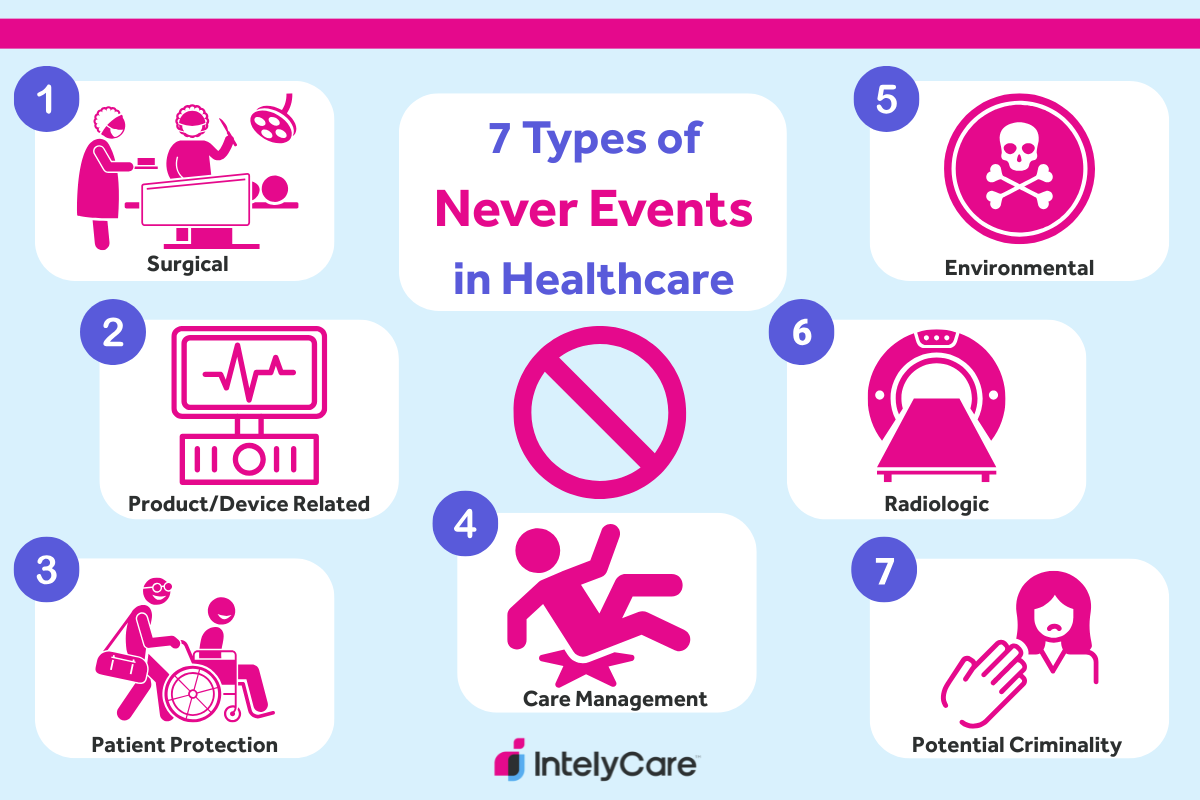
1. Surgical
Five of the 29 recognized healthcare never events belong to the surgical category. They include:
- Wrong site.
- Wrong patient.
- Wrong surgical or invasive procedure.
- Accidental retention of a surgical object.
- Intraoperative or immediate postoperative death.
Example:
A patient with a planned left-sided below-the-knee amputation has a right-sided amputation performed instead.
2. Product or Device-Related
Three healthcare never events belong to this category. They include severe injury or death related to:
- Delivery of contaminated drugs or biologics.
- Use or function of a device separate from the device’s intended use or function in the care setting.
- Development of an air embolism from clinical care interventions.
Example:
A nurse contaminates the spiked entry-point of the tubing that connects a bag of total parenteral nutrition (TPN) to a patient via central line access. This contamination results in a serious, life-threatening infection.
3. Patient Protection
Three events belong to this category. They include severe injury or death related to:
- The discharge or release of a patient (or resident) who is unable to make decisions to the care of an unauthorized party.
- Patient elopement.
- Patient suicide, attempted suicide, or self-inflicted harm in the care setting.
Example:
While the family member with medical power of attorney is away from the hospital, an elderly patient with dementia is discharged in the care of their non-authorized spouse who also suffers from dementia. They become lost in transit from the hospital, initiating a missing-persons crisis.
4. Care Management
The category with the most-assigned events, care management accounts for 9 of the 29 specified never events. They include severe injury related to:
- Medication errors (like the one cited in the above section).
- Unsafe administration of blood products.
- Complications associated with labor and delivery in an otherwise low-risk pregnancy.
- A patient fall.
- Development of a pressure ulcer in the care setting.
- The irretrievable loss of an irreplaceable biological specimen.
- Failure to follow up or communicate diagnostic test results.
Example:
An immobile patient isn’t turned every two hours to offload pressure and develops bedsores while inpatient. This complicates their care and leads to a prolonged hospital stay.
5. Environmental
Four events are categorized as environmental. They include severe injury or death in the healthcare setting related to:
- Electric shock suffered in the care setting.
- Oxygen (or other gas) delivery systems that either deliver no gas, the wrong gas, or gases contaminated by toxic substance(s).
- Burns incurred in the care setting.
- The use of physical restraints or bedrails in the care setting.
Example:
A combative, elderly patient in behavioral restraints suffers a bone fracture when trying to escape their restraints. Because of short staffing, their injury goes undiscovered despite the policy around safety checks with restraints, compromising healing and future mobility.
6. Radiologic
This is a new category and exclusively pertains to an event of significant harm or patient death due to the introduction of a metal object in an MRI area.
Example:
A patient on oxygen is taken to the MRI room still attached to their portable oxygen tank. The metal oxygen tank is yanked by the magnetic draw, striking the patient and causing significant injury.
7. Potential Criminality
The last category of healthcare never events, this includes four example events. They include severe injury or death in the healthcare setting related to:
- Someone impersonating a licensed healthcare provider (like a nurse or physician).
- The abduction of a patient.
- Sexual abuse of a patient while in the care setting.
- Physical assault of a patient while in the care setting.
Example:
A newborn baby is taken by someone who didn’t have the authority to leave with the infant because safety checks weren’t performed to ensure the child belonged to the person exiting the labor and delivery unit.
Responding to a Never Event in Healthcare
The seriousness of these events necessitates that healthcare providers proactively work to prevent never events in healthcare. Should a breakdown in safety occur, resulting in a mistake, we’ve also included some strategies for response.
| Never Event Preventative Measures | Never Event Response Measures |
|---|---|
| Standardize and tailor electronic health records to ensure stopgap safety checks with high-risk procedures like medication administration and surgeries.
Prioritize and promote open communication that encourages staff members to speak up and engage in interprofessional collaboration. Ensure a culture of safety by emphasizing the importance of reporting near-misses and errors and maintaining appropriate staffing. Provide ongoing training and education that incorporates the latest evidence for promoting and maintaining patient safety. |
Immediately intervene, halting the event and providing emergency care to mitigate the harmful effects of the event for the patient.
Notify the family and employ honest, clear communication about the event to signify respect, accountability, and professionalism. Examine the culminating factors that led to the never event and address the system failures in a timely manner. Document the event and resulting investigation, and implement organizational changes based on the findings. |
Strengthen Your Strategies for Ensuring Patient Safety
Nobody wants never events in healthcare to happen — they’re worst-case scenarios for everyone. Strengthen your preventative approach with IntelyCare’s expert-backed facility guides and best practice recommendations to promote patient safety and healthcare compliance.