Maslow’s Hierarchy of Needs in Nursing: A Quick Guide for Beginners


How can you apply Maslow’s hierarchy of needs in nursing? Nurses have to plan care that meets a broad array of needs, while prioritizing which issues to address first. Maslow’s theory categorizes these needs into five areas, which nurses can use to decide what interventions to address quickly and which ones can wait.
Nursing students typically learn about Maslow’s hierarchy during prerequisite classes like psychology and childhood development. Here’s an overview of this theory and its nursing applications.
Maslow’s Hierarchy, Explained
Created by Abraham Maslow in 1943, this framework breaks down the human experience into five levels of sequential needs, starting with the most elemental and progressing to the most complex. You’re most likely to see them arranged in a pyramid.
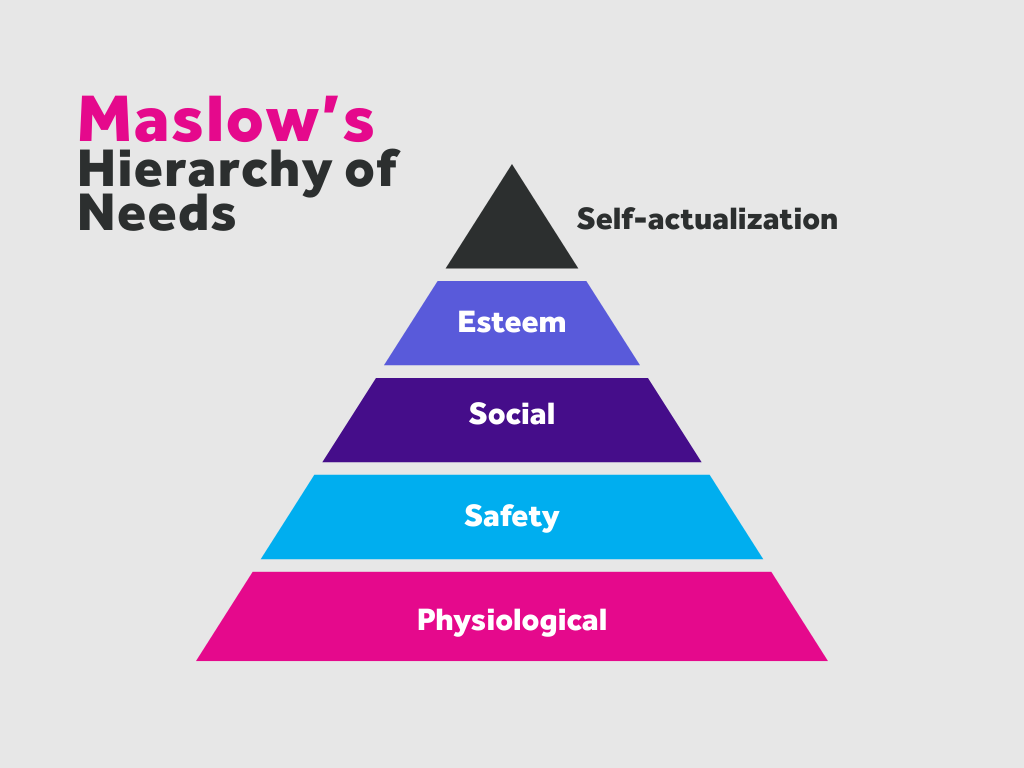
The categories are:
- Physiological: Basic necessities for survival, including shelter, food, and water.
- Safety: Sources of security, such as resources, income, and structure.
- Social: Connection with others, including friendships, intimacy, and a sense of belonging.
- Esteem: Feelings about oneself, including purpose, dignity, and achievement.
- Self-actualization: Achieving a greater level of personal expansion, creation, or exploration.
Maslow originally published this framework as the Theory of Motivation, and while it most obviously applies to individuals, it’s also been used in psychological studies, companies, advocacy groups, and more.
Criticism of Maslow’s Hierarchy
Maslow’s hierarchy offers a tidy way of summarizing a person’s individual needs, but it’s also come under scrutiny for several reasons. First, needs aren’t necessarily linear in the way the theory describes. People often seek to fill multiple needs simultaneously — it’s common to find a source of income and a social circle through work, for example. In certain parts of the world, basic needs may be unreliably met, but social connections and self-esteem can still be strong.
Additionally, the higher-order needs Maslow describes may not be priorities for everyone. This framework has a highly individualist lens, but some cultures operate more collectively, with the community as the focus rather than one individual. Maslow’s hierarchy is not the definitive word on human necessities, but an approach that allows people to think about basic needs and how they may be prioritized.
Applying Maslow’s Hierarchy of Needs in Nursing Practice
Nurses in post-acute and acute care are typically focused on the most basic elements of Maslow’s hierarchy: physiological demands and safety. But in some settings and situations, nurses may plan for other needs as well. Let’s explore some ways that nurses can integrate Maslow’s hierarchy into care.
Maslow’s Hierarchy of Needs and Nursing Prioritization
Nurses apply Maslow’s theory through prioritization methods like the ABCs — Airway, Breathing, and Circulation. When you notice a patient isn’t breathing, you stop everything to address that problem first. These items are at the bottom, most elemental level of Maslow’s hierarchy.
Safety is another area where nurses aim their focus in order to help patients experience optimal outcomes. Scheduled turns in the ICU are a way of keeping patients safe from sores and pressure injuries. Bed alarms in med-surg aim to stop patients from falling. A patient on chemotherapy precautions in an oncology unit is shielded from pathogens that may make them sick. These types of safety precautions help patients avoid injury, illness, and death.
Maslow’s Hierarchy of Needs and Care Planning
Nurses are likely applying Maslow’s hierarchy during care planning without even realizing it. When a case manager is planning for discharge needs, they’re thinking about basic body demands and safety first. Can the patient feed themselves? Are they able to walk without assistance? If they cannot leave the home, is there a community member who can help them with errands? Answering these questions helps nurses prioritize services.
Wherever you plan care, you might start to notice Maslow’s hierarchy. A psych nurse sees that a patient is stabilizing after a manic episode and may be ready for group therapy, progressing from safety to social needs. A home health nurse notes that a patient is experiencing low self-esteem due to mobility issues, so the nurse advocates for an electric wheelchair as well as teletherapy.
Maslow’s Hierarchy of Needs and Self-Care
One overlooked area where nurses can apply Maslow’s hierarchy of needs is in practical self-care strategies for themselves. Nurses are known for going an entire shift without a visit to the bathroom or a lunch break, but without proper nutrition and elimination, higher needs are difficult to accomplish. When nurses take great care of themselves, this can help them take care of patients without burning out from exhaustion.
Progressing up the pyramid, a healthy social life at work is essential. You don’t need to be best friends with your coworkers, but a comfortable working environment helps everyone perform better. And when nurses feel good about the care they provide, this can be a source of self-esteem and even self-actualization.
Check Out Other Theories in Nursing
Maslow wasn’t the only nursing theorist considering basic needs. Learn more about these nurse thinkers who developed theories about human necessities and how nurses work to meet them:
- Virginia Henderson outlined 14 basic needs, such as breathing, sleep and rest, avoiding dangers, and playing and recreating.
- Florence Nightingale created a theory of need focused on environmental comfort, including light, ventilation, cleanliness, and nutrition.
- Hildegard Peplau argued that the nurse-patient relationship is the cornerstone of care, with 4 distinct phases that progress throughout the care experience.
- Madeleine Leininger proposed a transcultural theory that outlines how to fit care to the cultural and spiritual needs of each patient.
Apply Maslow’s Hierarchy of Needs in Nursing Opportunities
If your basic needs aren’t being met at work, it might be time to explore other roles. We can help you find what you’re looking for with personalized job notifications.