How to Become a Forensic Nurse

In This Article |
|---|
|
Looking to add a dash of CSI to your nursing career? Forensic nursing is a career path that merges the worlds of healthcare and law enforcement, offering a unique opportunity to contribute to both well-being and justice. These professionals play an important role in the investigation and prosecution of crimes by applying their medical expertise to gather and document evidence of injury, violence, and abuse.
Wondering how to become a forensic nurse? This article has all the information you need. We’ll describe what forensic nurses do, how much they earn, and outline the required education and skills to become one.
What Is Forensic Nursing? Career Snapshot
- Mission: Unravel the mysteries behind injuries, violence, and abuse, ensuring justice and healing.
- Responsibilities: Use medical expertise to assess, document, and analyze evidence crucial to criminal investigations.
- Workplaces: Hospitals, law enforcement agencies, and forensic units.
- Path: Nursing degree, specialized forensic training, followed by optional certification.
- Perks: Thrilling work with real-world impact, like a medical detective solving puzzles.
- Cons: Intense emotional involvement and exposure to traumatic situations.
What Is a Forensic Nurse?
A forensic nurse is a registered or advanced practice nurse, who provides specialized care to patients affected by violence or victimization. Unlike other nursing specialties, forensic nurses may work with deceased patients. In such cases, their main role is to gather evidence for legal purposes and unravel the circumstances surrounding the person’s death to bring justice and closure to families.
As you learn how to become a forensic nurse, it’s important to understand who your typical patients might be. Here are some examples:
- Survivors of sexual assault or abuse who need medical care and evidence collection
- Victims of domestic violence who seek medical attention and support
- Children and teens who’ve faced physical or sexual abuse
- Elderly individuals experiencing neglect or mistreatment
- Inmates in correctional facilities experiencing abuse or needing healthcare services
- Individuals involved in accidents, homicides, or other traumatic events
- People with mental illness involved in crime or needing medical care
- Deceased individuals requiring autopsies to determine the cause of death
- Families who seek answers and closure following the death of a loved one
Forensic Nursing Types
In your journey to understand how to become a forensic nurse, it’s important to understand that forensic nursing is an umbrella term including many different specialties. Here are some types of forensic nurses and examples of their job duties:
- Autopsy nurse: Assists pathologists during postmortem exams, gathering specimens and documenting information.
- Correctional nurse: Provides care to people who are in the custody of the justice system, including people who are detained and incarcerated.
- Death investigation nurse: In the absence of a medical examiner, a death investigator nurse may be called upon to carry out an investigation into the cause and manner of death.
- Forensic geriatric nurse: Works to uncover elder maltreatment (neglect, abuse, and exploitation) and provides care to victims.
- Forensic nurse educator and trainer: Works in an academic environment to prepare future forensic nurses for the job.
- Forensic pediatric nurse: Provides care to children and adolescents who are victims of maltreatment (neglect, abuse, and exploitation).
- Forensic psychiatric nurse: Provides care to and evaluations on patients with mental illness, including offenders in the justice system.
- Legal nurse consultant: Provides clinical expertise to assess and analyze medical cases in the legal system.
- Nurse coroner: Assists coroners to determine cause of death.
- Sexual assault nurse examiner (SANE): Conducts thorough examinations on victims of sexual assault and provides medical care and emotional support.
What Does a Forensic Nurse Do?
You can think of a forensic registered nurse as the Sherlock Holmes of the healthcare world. One of the major tasks of these nurses is to perform a forensic examination — a full-body assessment performed to identify and document physical injuries to contribute to the investigative process. Other responsibilities forensic nurses have can include:
- Interviewing patients to gather information about their experiences, injuries, and medical history.
- Collecting and preserving forensic evidence such as DNA samples, photographs, and medical records.
- Collaborating closely with law enforcement and criminal justice agencies in evidence collection, documentation, and chain of custody procedures for forensic evidence.
- Accompanying law enforcement to crime scenes to provide medical expertise and assist in evidence collection.
- Assisting forensic pathologists in performing autopsies, and determining the cause and manner of death in cases of suspicious or unexplained deaths.
- Advocating for victims’ rights and promoting awareness of issues related to violence, abuse, and trauma.
- Providing compassionate care and support to survivors of trauma, including emotional and psychological support.
For more information, explore a sample job description for a forensic registered nurse.
How to Become a Forensic Nurse
Attaining adequate education is the first step on the path to becoming a forensic registered nurse. Here’s a general overview of the forensic nurse requirements you must meet to step in to this profession.
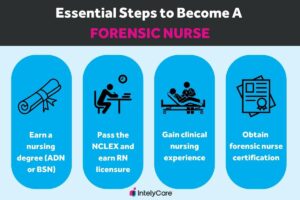
1. Get a Nursing Degree
Begin by earning a nursing degree. While an Associate Degree in Nursing (ADN) is the quickest option, a Bachelor of Science in Nursing (BSN) degree is a more comprehensive education. Nurses that complete a BSN program have an advantage when it comes time to apply to jobs.
2. Obtain Nursing Licensure
Once you finish your nursing program, get your nursing license by passing the National Council Licensure Examination for Registered Nurses (NCLEX-RN). This exam ensures that nurses have the knowledge and skills necessary to provide safe and effective care in various healthcare settings.
3. Gain Clinical Experience
Get nursing experience — it’s key to building your clinical skills. Many forensic RNs begin their careers in med-surg units, offering them the chance to acquire a wide range of skills. Here are some other work environments to consider:
- Critical care units
- Emergency departments
- Intensive care units (ICUs)
- Progressive care units
- Trauma centers
4. Pursue Forensic Nurse Certification
Although getting certified and completing specialized forensic nursing programs isn’t mandatory to work in this niche, it shows your dedication to the specialty. There are a few certifications for forensic nurses and forensic nurse practitioners that you might want to explore. These are offered by the International Association of Forensic Nurses (IAFN):
- Sexual Assault Nurse Examiner – Adults/Adolescents (SANE-A)
- Sexual Assault Nurse Examiner – Pediatric/Adolescents (SANE-P)
- Advanced Forensic Nursing (AFN-BC)
Additional credentials that can be useful to forensic nurses include the Trauma Nursing Core Course (TNCC) and the Trauma Certified Registered Nurse (TCRN) certification.
How Long Does It Take to Become a Forensic Nurse?
The length of time it takes to become a forensic nurse varies based on your educational path. The quickest path to becoming a nurse involves completing a two-year associate degree in nursing program, followed by gaining at least two years of clinical experience. However, it generally takes at least six years to begin working in this field.
How Much Do Forensic Nurses Make?
Forensic nurse salaries vary greatly based on location and the facilities in which they work. The average forensic nurse salary is around $65,500 per year but can differ depending on your years of experience, certifications, location, and more. Exploring opportunities elsewhere? Consider submitting your nurse resume to one of these top-paying states:
Top Skills for Forensic Nurses
Communication. Since interviewing patients is a key part of a forensic nurse’s job, you must have exceptional interpersonal communication skills with people of all ages and backgrounds. Be an active listener to make sure you correctly record facts and events. And be very communicative during any examination of a patient to let them know what you will be doing during each step of the process.
Attention to detail. Forensics can involve working with evidence samples, and this demands that you be both scrupulous and organized.
Empathy. Treating patients who have experienced any kind of traumatic event requires sensitivity and compassion. This skill helps build trust between the patient and you during a time when their sense of security has been shaken.
Professionalism. No part of a nurse’s job is ever meant to be performed casually, and this is especially true when you’re collaborating with government officials and law enforcement. Follow the chain of command and perform your duties promptly and correctly.
Where Do Forensic Nurses Work?
Some forensic nurses work in locations that are typical to nursing, while others work in facilities that don’t specialize in healthcare:
- Medical examiner offices
- Psychiatric institutions
- Correctional facilities
- FBI
- CIA
- Local police departments
- Hospitals
- Active crime scenes
Ready to Become a Forensic Registered Nurse?
We’ve answered your questions about how to become a forensic nurse. Now, are you ready to explore exciting career opportunities? IntelyCare can match you with nursing job postings that align with your skills and interest areas.