CNA Resume Writing Tips and Sample


Certified nursing assistants (CNAs) are highly valuable members of the healthcare team and are in demand. Simply put, skilled nursing facilities can’t exist without a team of dedicated, hardworking CNAs that provide essential support to registered nurses and the administration in caring for patients and residents.
The good news for all you CNAs is that you have solid job security and job options. However, you still need to write a stellar CNA resume to help you impress a hiring manager and secure a nursing assistant job interview.
Your nurse assistant resume is a crucial element in your job application. A resume is a document that outlines your key qualifications, work experience, skills, education, and certifications. It’s often the first impression a recruiter or hiring manager has of you, so it’s important to showcase your particular abilities in a clean, professional manner. Along with a CNA cover letter, a resume communicates to your future employer why you are uniquely qualified for the job.
Resume Writing Tips for CNAs
When writing your nursing assistant resume, use these tips to guide you:
1. Use Language That Mirrors What You See in the Job Ad
Healthcare recruiting is not for the faint of heart. A hiring manager may receive dozens — sometimes hundreds — of applications for a single position. Who has time to review every single one of those resumes, put aside the ones that look promising, and then go back and select the final batch? Nobody!
Companies might employ applicant tracking systems (ATS) or AI to scan resumes and look for the ones that use similar language to the language that appears in the job posting.
This is why it’s critical that you create a tailored resume for each job that you wish to apply to. As you know, not all jobs have the same requirements. Carefully read the CNA job ad and home in on keywords to include in your resume. If a facility is using technology to screen resumes, your usage of these keywords might impact your chances of making the cut.
For example, if you see that a facility mentions that it is looking for candidates that have experience “documenting food/fluid intake” and “assisting with special oral feeding techniques,” use those phrases in your resume (assuming you have experience performing those duties, of course). Yes, it takes a bit longer to tailor a resume, but the payoff can be substantial.
2. Quantify Your Job Duties Whenever Possible
Numbers on resumes can have a remarkable way of making hiring managers sit up and pay attention. What gives you a clearer picture of a candidate — one who writes, “Assisted with meal preparation and feeding of residents,” or one who writes, “Assisted with the meal preparation and feeding of 15 residents three times per day”?
Including numbers wherever you can helps give readers a better idea of your workload and, in turn, reflects your levels of responsibilities. So be precise when describing your experiences. Say you have “180 practice hours” rather than “a lot of experience.”
3. Use Action Verbs to Give Your Resume a Lift
When describing your duties from previous jobs or clinical hours, make your bulleted lists start with descriptive action verbs. Some to consider:
- Administered
- Advocated
- Aided
- Consoled
- Educated
- Facilitated
- Documented
- Improved
- Informed
- Monitored
- Provided
- Recorded
- Supported
4. Make It Skimmable
Formatting is a critical element of resumes. Avoid long paragraphs. Keep it concise — make it as long as necessary and as short as possible. As mentioned, hiring managers and recruiters may receive a large volume of applications. Put yourself in their shoes. Use bullets where appropriate and leave enough white space on the page so the reader doesn’t feel like they’re staring at a block of text. Tip: You can ask AI to format your resume so that it’s easily readable and professional-looking.
5. Avoid Careless Oversights
Applying to jobs can be stressful, and that can distract you from the details. Before you submit your resume to an employer, read it carefully. Run a spell check. It’s the little things that can trip you up. Is your contact information correct? Did you spell the name of your currently employer correctly? Did you include all necessary information requested in the job ad? Have someone else read your resume with a fresh set of eyes. They might spot something you overlooked.
Bonus tip: If you see a job that interests you, don’t wait to apply. Recruiters and hiring managers are looking to fill positions yesterday. The sooner you can submit your application, the more likely it is that you’ll be considered for the job.
Read on below for a sample CNA resume. Examples of other nursing resumes can give you additional ideas.
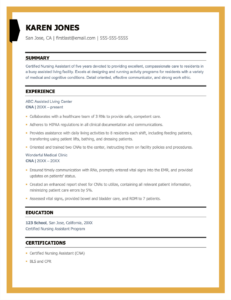
CNA Resume Sample
KAREN JONES
San Jose, California | firstlast@email.com | (555) 555-5555
Certified Nursing Assistant of five years devoted to providing excellent, compassionate care to residents in a busy assisted living facility. Excels at designing and running activity programs for residents with a variety of medical and cognitive conditions.
Key Qualifications
- Detailed oriented, effective communicator, and strong work ethic
- Possesses active CNA license in California
- Collaborates with healthcare team of three RNs to provide safe, competent care to 50 residents
Education
123 School, San Jose, California20XX
Certified Nursing Assistant Program
Professional Experience
ABC Assisted Living Center, CNA, 20XX – present
- Adhered to HIPAA regulations in all clinical documentation and communications.
- Provided assistance with daily living activities to eight residents each shift, including feeding patients, transferring using patient lifts, bathing and dressing patients.
- Oriented and trained two CNAs to the center, instructing them on facility policies and procedures.
Wonderful Medical Clinic, CNA, 20XX – 20XX
- Ensured timely communication with RNs, promptly entered vital signs into the EMR, and provided updates on patients’ status.
- Created an enhanced report sheet for CNAs to utilize, containing all relevant patient information, minimizing patient care errors by 5%.
- Assessed vital signs, provided bowel and bladder care, and ROM to seven patients.
Skills
Organization; Empathy; Patience; Cultural Awareness; Flexibility
Certifications
- Certified Nursing Assistant (CNA)
- BLS and CPR
Main Sections of a Professional CNA Resume
From top to bottom, these are the sections that hiring managers will be expecting to see on your resume.
Name and Contact Info
You don’t need to include your street address. Your name, city, phone number, and email address will suffice. Add your LinkedIn profile URL if you have one.
Career Summary
A career summary is a short paragraph (two to three sentences) that gives the reader a quick overview of your qualifications, including your years of experience and any achievements or accolades you have, as well as what makes you exceptional at your job.
For example, an experienced CNA might write: “Dedicated CNA with 12 years of experience caring for elderly and critically ill residents in high-volume skilled nursing facilities. Recognized for working seamlessly with RNs and LPNs to deliver compassionate, empathetic care while providing support to residents’ family members. Reliable, professional, and outgoing demeanor.”
An entry-level CNA might write: “Responsible CNA with 18 months of experience in high-volume nursing home. Commended for taking initiative, keeping residents’ rooms clean and tidy, and assisting staff with administrative tasks. Enjoys creating a welcoming, nurturing environment.”
Professional Experience
For each facility, include your title, the name of the facility, the city and state of the facility, and the years you were employed there. Then create a bulleted list that describes your responsibilities and achievements. Don’t make your experience section just a simple list of tasks — hiring managers are familiar with the duties of a CNA. Talk about what you did, for how many people, and what the end result was.
Education and Certifications
Let readers know how you became a CNA. Include the name of the training program, along with city and state, and the year you completed the program. Then list all relevant certifications such as “CNA, Texas Health and Human Services” or “CNA, the Nurse Aide Registry Program of Massachusetts.”
Key CNA Resume Skills
When it comes to writing a CNA resume skills section, heed this warning: All CNA skills are not created equal. Make sure the skills you include in this bulleted list are relevant to the job at hand.
If you’re applying to a job in a hospital, the nursing assistant resume skills you choose to include may vary slightly from the ones you’d put on a resume for a job in a long-term care facility. Be sure to closely read each individual job ad to see which responsibilities the employer lists and then mirror those on your resume.
Here are some common CNA resume skills and responsibilities to consider including:
- Transferring patients
- Bathing patients
- Perineal care
- Oral care
- Safely feeding patients
- Vital signs
- Hand washing
- Range of motion exercises
- Nail trimming
- Communication and documentation
1. Transferring Patients
Injured and elderly patients need to complete activities of daily living (ADLs) to maintain their quality of life and prevent further deterioration. It’s important for CNAs to help transfer patients safely and avoid falls during these activities. Your resume and cover letter should describe different lifts with which you have experience — such as the Hoyer or sit-to-stand lifts — and other techniques you use to ensure safety during transfers.
2. Bathing Patients
The importance of bathing is far more than feeling refreshed — personal hygiene is an important aspect of health. You could describe your experience with partial and full body baths, your mindfulness of skin tears, and your knowledge of which medical devices cannot be submerged.
3. Perineal Care
Proper perineal care, especially for female patients, is necessary to avoid UTIs and vaginal infections. Describe your ability to educate regarding perineal hygiene, and how you assess for skin breakdown and fungal infections.
4. Oral Care
Oral care is one of the most important CNA skills because, without it, patients are more likely to face a decline in their ability to eat and be more prone to a variety of ailments. Include your experience with cleaning dentures, checking for sores, and providing input if a patient’s ability to chew and swallow is impacted by their oral health (or lack thereof).
5. Safely Feeding Patients
CNAs must recognize when it’s safe to feed patients, and if their diet is the right match for their ability. They also observe for signs of aspiration — the inhalation of food or beverages — and must assist patients if this occurs. Explain how you monitor and document your patients’ consumption, ensure their prescribed diets are upheld, and encourage them to eat when need be.
6. Vital Signs
Obtaining vital signs is among the most foundational CNA skills. In some facilities, CNAs are responsible for getting daily vital signs and communicating them to the RN. This data is necessary to monitor your patients’ overall health and could be a key part of catching the beginnings of an ailment before it worsens.
You can mention the vitals you’re routinely responsible for, how you use therapeutic communication with difficult patients, and your process for documenting and communicating these findings.
7. Hand Washing
As nursing professionals, we’ve been told about the importance of hand washing over and over again — and for good reason. Good hand hygiene can stop the spread of various diseases. When you prioritize hand washing, you gain peace of mind knowing you didn’t contribute to a patient’s illness from working with unclean hands.
In your resume and/or cover letter, mention how you thoroughly wash your hands after dealing with body fluids, as well as before and after feeding patients. It’s also good to mention sanitizing your hands between patients and whenever else you deem it necessary.
8. Range of Motion Exercises
Many elderly patients need range of motion (ROM) exercises to maintain mobility. CNAs, along with other members of the healthcare team, must strike the balance between helping patients complete these exercises effectively and not accidentally injuring them in the process. Be sure to discuss different ROM routines you’ve done in the past. You can also share the types of injuries and ailments that you’ve addressed with these exercises.
9. Nail Trimming
Like bathing, nail trimming is about more than aesthetics. It’s one of the underrated CNA skills, but it’s far more important than you think. Nails harbor bacteria that could lead to infections from something as insignificant as a scratch. Trimming them regularly without harming the patient goes a long way in implementing preventative care. Consider highlighting how you perform this task with gentleness and care.
10. Communication and Documentation
Prompt communication and accurate documentation are integral to ensuring patient needs are met in a timely manner. List the electronic medical record (EMR) and hand-off report systems with which you have experience, and explain how you communicate pertinent information to the healthcare team.
What CNA Salary Can I Expect?
After you have prepared your nursing assistant resume, you are ready to begin applying for jobs. You might be wondering what type of salary you can expect.
The Bureau of Labor Statistics reports that the average salary for a CNA is $41,270 per year. This number depends on a few variables: your location, years of experience, certifications, and facility type. You may earn more money in travel CNA jobs because of the increased need for your skills.
The following metropolitan areas that employ the highest number CNAs:
The following states/areas pay the highest annual salaries to CNAs:
Note that the demand for CNAs in your location can also influence what you earn. For example, Texas and Florida are two of the top five states that employ the most nursing assistants in the country, but Oregon and Washington have the highest average annual salaries ($49,970 and $49,960, respectively). Use an online salary calculator to see what you may earn in your area.
Put Your CNA Resume to Work
Now that you’ve learned what an awesome nurse assistant resume looks like and have made your own, you are ready to put it to use. Need help finding the perfect job for you? Check out the CNA jobs available with IntelyCare today.
Latest Jobs
Error: Failed to parse RSS: String could not be parsed as XML