5 Signs of a Bad Hire in Healthcare


Your hiring process has always yielded fantastic team members, but this latest hire can’t seem to navigate job expectations or embrace departmental culture. You’re not alone in this experience. From a survey of 2,000 hiring managers, nearly three-quarters reported a bad hire. Meaning, there’s a high likelihood that even with the best hiring program in place, a misalignment is statistically bound to occur.
In this article, we’ll give you five warning signs of a mismatched hire with examples that may alert you to the issue and suggestions to help you both to avoid hiring mistakes and to follow up with new hires to make sure they’re on the right track.
How Do Bad Hires Happen?
If you’re racking your brain for what went wrong in the process, it’s time to give yourself some grace. The list of reasons for an unsuitable hire could be endless, and may have nothing to do with your process. Here are just a few examples of how a seemingly excellent candidate may end up being bad for the job.
- The new job required a move that caused undue stress and burden on the hiree’s family, leading to trouble with productivity and integration.
- Exaggerated skill sets and misrepresentation may have led to an excellent interview that’s not translating well to the workplace.
- Elongated hiring processes can lead to missed opportunities to recruit the best candidates, leaving managers the choice between short staffing or the less qualified candidate alternative.
What’s the Cost of a Bad Hire in the Workplace?
The Department of Labor estimates that bad, or misaligned, hires can cost institutions as much as 30% of the first year’s wages. This means that given the current national average salary of $98,430 for RNs in the U.S., a healthcare employer could lose nearly $30,000 per mismatched hire. The price goes beyond the tangible sunk cost, though. Intangible effects could include:
- Unreliable staffing.
- Decreased productivity and teamwork issues.
- Negative morale harming a once healthy work environment.
- Worse retention rates, because studies have shown that bad hiring decisions may account for 80% of employee turnover.
5 Signs of Bad Hires in Healthcare
A lot of times, the red flags begin with the resume. If a candidate somehow slipped between the cracks of your vetting process, here are some clear signs that they’re not taking advantage of the opportunity to become an effective member of your organization.
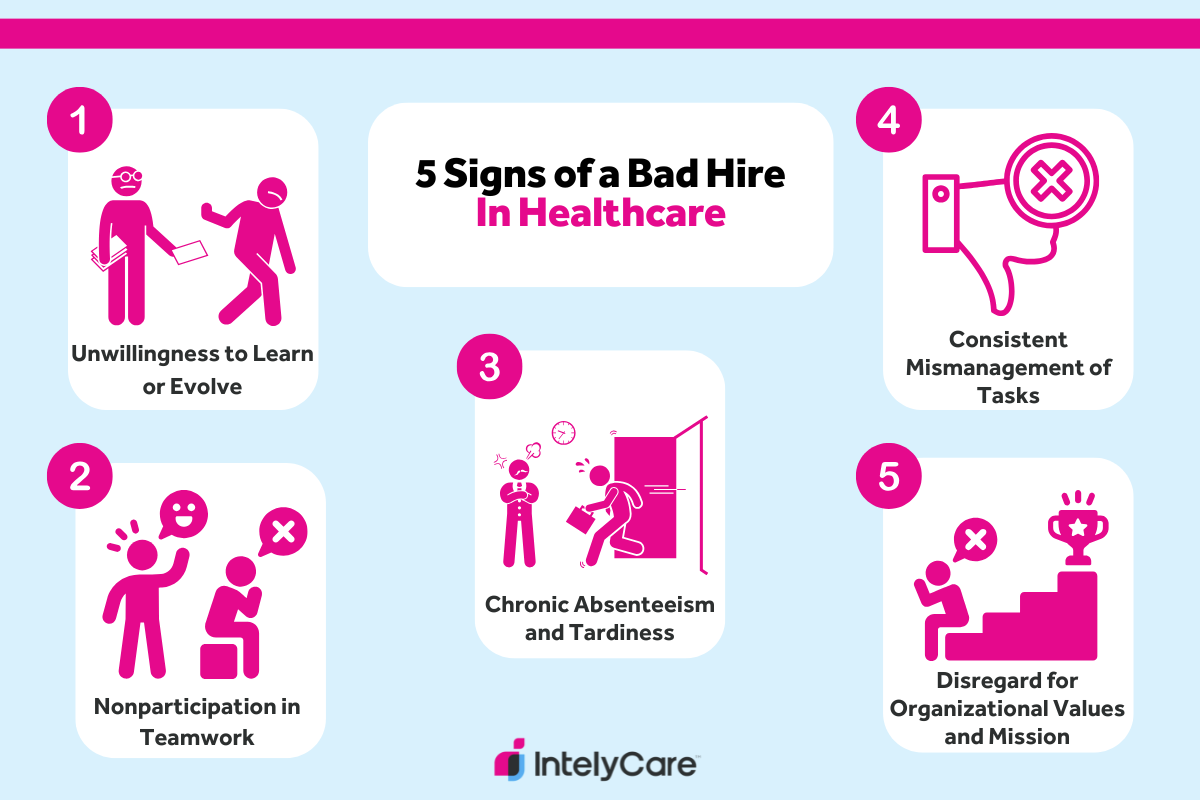
1. Unwillingness to Learn or Evolve
Nursing is a field that requires lifelong learning. The willingness to adapt and incorporate ongoing education strongly correlates with better patient outcomes. If a new hire isn’t willing to ask questions while growing their practice and skillset, this is a major red flag and could risk patient safety and wellbeing.
Examples include:
- Refusing to employ facility-specific best practice measures and sticking to old habits.
- Excusing subpar work because that’s how they’ve always done it, or because it met the standard at their old job.
2. Nonparticipation in Teamwork
Teamwork doesn’t just benefit morale, interprofessional collaboration has shown to improve patient outcomes and satisfaction, increase efficiency, and reduce healthcare costs. So, a new employee who refuses to cooperate with other staff members isn’t just being unfriendly, they’re actively impeding safe care delivery and the facility’s bottom line.
Examples include:
- Refusing to help fellow employees with tasks that require multiple staff members to achieve safety, such as patient handling (turns, lifting, and repositioning, for example).
- Frequently missing team functions like safety huddles, shift handover, and routine department check-ins and meetings.
3. Chronic Absenteeism and Tardiness
In healthcare, safe staffing and the maintenance of appropriate patient-to-staff ratios is often a matter of regulatory compliance. When a new hire consistently demonstrates unreliable job attendance, it can contribute to costly short staffing, a risk already plaguing many healthcare organizations.
Examples include:
- Frequently clocking-in a few minutes late to shift (or consistently “forgetting” to clock-in to cover for tardiness), causing overtime for the outgoing nurses responsible for shift handover.
- A pattern of missing work, or a no-show no-call absence occurrence, requiring a last minute scramble to maintain adequate staffing.
4. Consistent Mismanagement of Tasks
Given the pressure of working in healthcare, time management is a critical skill. Bad time management can lead to decreased productivity, lower patient satisfaction, and poorer outcomes. If a new hire isn’t prioritizing effectively or thinking through the nursing implications of their work, patient safety could be at real risk.
Examples include:
- A pattern of not following the proper steps of care. For example, not checking blood pressures before administering antihypertensive medication.
- Consistently failing to stay on top of ordered tasks within their patients’ care plans.
5. Disregard for Organizational Values and Mission
Organizational culture isn’t just crucial for ensuring value-based care and good patient outcomes, it helps create a healthy work environment and reduces the risk of burnout. Disregard for the principles and tenets that guide the mission statement jeopardizes quality of care and the facility’s healthcare reputation.
Examples include:
- Frequent complaints from patients about poor bedside manner and quality of care provisioned.
- Proof or concern that documentation is being falsified, maybe as a result of gaps in care or work that cut corners.
How Can Facilities Handle Unsuitable Hires?
Hiring managers and healthcare leadership can reduce the risk of facility impacts from a misaligned hire via two approaches: risk mitigation and follow-up. See below for examples of both those strategies in practice.
| Strategies to Avoid an Unsuitable Hire | Follow-Up Strategies for an Unsuitable Hire |
|---|---|
| Utilize evidence-based hiring practices to guide the recruitment and interviewing process.
Invest in quality job descriptions that clarify and fully detail the expectations and responsibilities. Consider a collaborative interview approach to ensure decisions are organizationally minded rather than individually. Standardize onboarding and initial training processes to ensure thoroughness and consistency. Routinely reflect on and reform the hiring process to ensure that new research and best practice recommendations are incorporated into program updates. |
Check in as soon as there’s a problem and increase the frequency of feedback and onboarding debriefs.
Utilize mentoring programs and other resources to assist new employees. Target education and training to address the deficiencies or specific areas of struggle. Initiate a performance improvement plan (PIP) for the new hire and follow up on action items. Involve HR and consider options for reassignment or termination if necessary. |
Ready to Recover Your Team and Departmental Culture?
The unfortunate truth is that bad hires happen to every organization. Mitigate the risk of it happening again and refresh morale and productivity by connecting with high quality professionals today.