Surgical Tech Performance Evaluation: Examples and Tips


Surgical technologists, often referred to as surgical techs, perform essential roles on surgical teams and have a direct impact on patient care outcomes. If you’re in a supervisory position, conducting surgical tech performance evaluations is an important way that you can promote safety and high standards in the surgical department of your facility.
Though the position is considered entry level, this role carries significant responsibility. Your surgical tech’s clinical competency, ability to perform as part of a fast-moving team, and depth of knowledge of disease processes and surgical procedures are all vital components of the role. An annual performance evaluation is your chance to identify areas that need improvement and determine professional development goals.
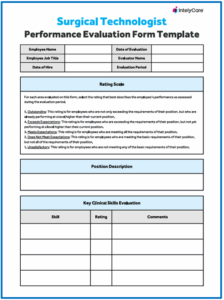
Additionally, performance evaluations with your healthcare team present opportunities to encourage positive behaviors and show appreciation — which can be highly motivating. We’ll go over ways that you can deliver a thorough evaluation of your surgical tech’s performance, address challenges, and promote engagement. We’ll also discuss tips and examples that will help you with documentation. If you need a convenient starting point, be sure to download our surgical tech evaluation form template.
Before You Begin the Evaluation Process
As you get ready to evaluate a surgical tech under your supervision, it can be helpful to consider challenges of the job. Surgical techs often work in hospitals, and may spend entire shifts on their feet. They have one of the highest rates of work-related illness and injury of all occupations due to biological, chemical, physical hazards experienced in the operating room (OR). Because of the sometimes unpredictable nature of surgical procedures, scheduling may be erratic, with frequent on-call, night, weekend, or holiday shifts.
Steps in the Surgical Tech Performance Evaluation Process
A successful performance evaluation will address these challenges and identify ways to meet and overcome them for continued (or improved) job satisfaction. This important conversation will involve giving the surgical tech feedback, and also accepting feedback so that you can better understand the current status of your facility’s operating rooms.
The process should be standardized and approved by your agency’s human resources (HR) department and relevant administrators. Here’s an overview of the typical steps involved in one review cycle:
- Deliver surgical tech self-evaluation forms and explain self-assessment requirements.
- Schedule the meeting.
- Gather information from the surgical team about the tech’s performance in the OR. Speak to surgeons, anesthesiologists, and perioperative nurses. If the tech is relatively new, consult with their preceptor or mentor.
- Reflect on the tech’s performance and prepare documentation.
- Conduct the evaluation.
- Follow up with the surgical tech at appointed intervals regarding goals.
Documenting With a Surgical Tech Evaluation Form: Examples and Tips
Documenting your surgical tech performance evaluations ensures that the process is transparent and communicated effectively. The forms you use will guide the process and encourage efficiency during the in-person phase. Because of this, it’s a good idea to do up-front work to verify that your records cover the necessary information.
Your facility’s documentation should be customized to fit not only your employee assessment process in general, but also the expectations of the surgical techs within your organization. While the core responsibilities center around helping in the operating room, duties vary depending on the size of the facility, the types of procedures offered, and size and structure of the surgical team.
Our surgical tech performance evaluation template provides a potential layout that covers essential information, including skill assessment and goal setting. Here’s a breakdown of what each section of the form covers and examples of how to use it.
1. Identifying Information and Job Title
The first section of the surgical tech performance evaluation form will cover the employee’s name, your name, and the date of the evaluation. You’ll also record the exact job title according to the employee’s hiring paperwork, which might be:
- Surgical technologist
- Surgical technician
- Surgical assistant
- Surgical first assistant
- Operating room technician
In addition, you’ll record the review period. Evaluations typically occur on a routine schedule, such as biannually or annually. They may also be performed for situational reasons, such as the end of an orientation or as follow-up for disciplinary action.
Tips:
- Take note of the employee’s title and pursue information about the reasons behind it. Within some healthcare organizations, surgical technologists have undergone more rigorous training programs than surgical technicians. Those who have “assistant” in their title may have worked in the OR for 2-3 years before advancing.
- Celebrate techs who have been with your healthcare organization for an extended period of time. They’ve faced hazards in the OR shift after shift, and remain committed. This is a feat worth acknowledging.
Example:
| Employee Name | Anne Howe | Date of Evaluation | 06/01/20xx |
| Date of Hire | 01/01/20xx | Evaluator Name | Ghanay Bell |
| Employee Job Title | Surgical Technician | Evaluation Period | 01/01/20xx-05/29/20xx |
2. Rating Information
The next section of your evaluation form should elaborate on the rating scale that you and the tech will use to examine their performance in the OR. Typically, rating methods are based on numbers, narrative, or a combination of both. Using a combination is helpful because it generates numeric data for comparison and tracking purposes, while also digging deeper with explanations and examples.
For surgical techs, the numeric scale portion of the rating method should cover a range of performance levels to account for the nuances of the job. For example, a tech’s ability to use aseptic techniques will involve not only proper gowning and gloving practices, but also adapting to unexpected situations and coordinating with other team members who may or may not be following proper technique.
Tips:
- Don’t wait until the weeks before a performance evaluation to discuss the process with the surgical techs under your supervision. Instead, hand out the relevant forms during onboarding and introduce the procedure. This will help them know what to expect and aim for.
- When you ask your surgical techs to perform self-assessments, highlight the ways the information can be used to improve performance of the individual and the team. Surgical techs are often team-oriented.
Example:
| 5. Outstanding | This rating is for employees who are not only exceeding the requirements of their position, but who are already performing at a level higher than their current position. |
| 4. Exceeds Expectations | This rating is for employees who are exceeding the requirements of their position, but not yet performing at a level higher than their current position. |
| 3. Meets Expectations | This rating is for employees who are meeting all of the requirements of their position. |
| 2. Does Not Meet Expectations | This is for employees who are meeting the basic requirements of their position, but not all of the requirements of their position. |
| 1. Unsatisfactory | This is for employees who are not meeting any of the basic requirements of their position. |
3. Surgical Tech Clinical Skills Evaluation
This portion of the form will clarify several essential skills that the tech uses on a routine basis to successfully perform their job. This portion is for clarifying your assessment of performance, and will also serve as the surgical tech self-evaluation documentation. This segment should address clinical skills, such as:
- Operating room preparation
- Identification of tools and supplies
- Aseptic technique
- Patient care and patient positioning
- Knowledge of specific surgeries and procedures
- Understanding of disease processes, particularly intra-operative complications
You may also assess the tech’s soft skills, such as:
- Teamwork
- Communication
- Time management
- Task prioritization
- Attention to detail
Since the position involves many hands-on tasks, it may be challenging to decide which clinical skills to list on your surgical tech performance evaluation. Checklists used during the tech’s orientation period may be a helpful resource, but will need to be fine-tuned to fit the purpose of the evaluation. This check-in is not about gauging competency in long lists of singular tasks, but rather assessing critical performance areas, providing feedback, and promoting engagement.
Tips:
- Focus on non-negotiable skills that are related to patient safety, such as maintaining a sterile field.
- If you don’t often work in the OR, seek input from team members who work with the tech on a regular basis to discover patterns in behavior.
Example:
| Skill | Rating | Comments | |||
| Maintains sterile technique | 3 | Surgical Tech Perspective:I am very careful when around a sterile field, because I know how important this is to patient safety. I am getting better at using controlled movements when stepping up to the surgical table, and I can still move efficiently and in coordination with the rest of my team. I don’t get as flustered as I used to during emergencies, but my hands still shake. | |||
| Maintains sterile technique | 4 | Nurse Leader Perspective:I have heard from several of [surgical tech’s] colleagues that she constantly maintains sterile technique during procedures. On several occasions she recognized breaks in the surgical technique of team mates and spoke up with recommended corrective actions. Our OR nursing staff reports that she is handling sterile supplies with greater efficiency, including during stressful and urgent incidents that require rapid response from the entire team. | |||
4. Goal Setting
In this section, you’ll work with the surgical tech to identify key goals that would be worthwhile to pursue. There are different ways you can approach this process, depending on your leadership style. For example, you could ask the tech to prepare for the evaluation by brainstorming possible goals, and refine them to come into alignment during your one-on-one.
Tips:
- To decide on goals, consider the employee’s challenges and pain points. Where is improvement needed the most, and why? For example, a surgical tech who consistently struggles in the area of teamwork may experience anxiety before coming to work, because they don’t feel confident interacting with teammates. Improving this area of job performance would contribute to the tech’s health and overall sense of job satisfaction.
- When working with the tech to set goals, encourage specificity by explaining the SMART goal format.
Example:
| Professional Development Goal | [Surgical tech] will successfully mentor a new-hire surgical tech within one year.Rating: |
| Evaluator Comments | I plan to work with our department clinical educator to update the materials for our surgical tech mentor program. I will deliver copies to [surgical tech] within two weeks. I will assign a new hire to [surgical tech] within three months and provide support and resources when questions arise. |
| Employee Comments | I plan to approach this opportunity with a willing attitude and ask my supervisor for help if I come up against challenges as I take on this new responsibility. |
Ready for More Leadership Insights?
We know that conducting surgical tech performance evaluations isn’t the only challenging aspect of your job. That’s why we offer streamlined healthcare insights and guides created to provide the essential information you need, without the headaches.