Licensed Practical Nurse (LPN) Performance Evaluation: Examples and Tips


The licensed practical nurses (LPNs) on your staff are important team members who can contribute to the success of your facility. However, research shows that these professionals often feel undervalued in the workplace. In this article, we’ll provide you with LPN performance evaluation examples and tips to help you conduct your next LPN appraisal in a way that both recognizes their vital role and encourages their professional development.
Though delivering feedback to your nursing staff may feel daunting at times, it’s necessary to develop the professional team caring for your patients. Research shows that individuals become high performers when skills that need improvement are identified, practiced, and evaluated. This is especially true in practical nursing, a skills-driven profession.
The right approach may help you deliver motivating guidance, support your staff LPN’s professional development, and uplift your healthcare organization. Let’s dig deeper into the practical steps you can take to level-up your LPN performance evaluations. Before we begin, consider downloading our templated LPN performance evaluation form.
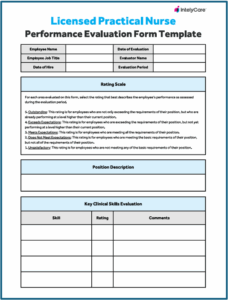
LPN Performance Evaluation Process
LPNs (called licensed vocational nurses, or LVNs, in some states) may perform a variety of duties that range from direct patient care to supervising agency personnel. Despite this variety in job duties, there are some core aspects of the LPN evaluation process that are consistent across care settings. Here’s an overview of the typical steps involved in one review cycle:
- Notify the LPN of the upcoming evaluation in advance and distribute the appropriate forms.
- Request that the LPN complete self-assessments in advance.
- Reflect on the LPN’s performance and prepare documentation.
- Conduct the in-person (or virtual) performance evaluation.
- File documentation.
- Follow up with the LPN according to the needs determined during the evaluation.
Your performance evaluation process will need to be highly customized to the LPN job duties within your facility or agency. For example, LPNs working at long-term care facilities may oversee multiple certified nursing assistants (CNAs) and medication aides. Consulting with these employees to assess the LPN’s leadership abilities will be an important step in preparing for the performance evaluation.
For LPNs working in acute care settings, clinical competency may be the focus of the evaluation. Your preparation may involve auditing charts, reviewing patient experience surveys, and speaking with RNs on staff who partner with the LPN to deliver care.
Documenting Your LPN Performance Evaluation: Examples and Tips
Your facility may have a protocol for documenting your nursing staff performance evaluations. If not, collaborate with facility leaders, educators, and your human resources department to create standardized documents. The forms you use during the LPN appraisal process should be tailored to the role to ensure that the correct clinical skills and softs skills are addressed.
It may be a good idea to update your LPN evaluation forms on a regular basis to reflect any changes to this particular role at your facility. An LPN’s duties may evolve to reflect updates to state and federal regulations, unit needs, patient census, and staffing models.
Whether you’re creating a new form or updating an existing one, using a customizable template can give you ideas and save a lot of administrative time. Effective forms should cover all aspects of an evaluation, from clinical skills assessments to goal setting. Looking at LPN performance evaluation examples is a great way to inspire your own process. Below, we’ll break down each section of a typical form and give you tips for successful implementation.
1. Identifying Information and LPN Job Details
In this section of the evaluation form, you’ll introduce the specifics of the evaluation including the date of the one-on-one and the frequency of the performance evaluation. For LPNs with supervisory duties, you may want to create a field to document the specific number of employees they oversee.
Tips:
- Higher-level management may access your performance evaluations in the future, especially if issues with the LPN come up, so follow good record-keeping standards and check dates for accuracy.
- Use the employee’s full, legal name exactly as it appears on their nursing license. This will facilitate efficient recall and cross-referencing of documents for yourself, other facility administrators, and your HR department.
Example:
| Employee Name | Omar Lewis | Date of Evaluation | 06/01/20xx |
| Date of Hire | 01/01/20xx | Evaluator Name | Sara Stein |
| Employee Job Title | Licensed Practical Nurse | Evaluation Period | 01/01/20xx-05/29/20xx |
2. Rating Information
The next section of the evaluation should clearly define the rating method you and the LPN will use for assessing their performance.This method may incorporate numbers, narration, or a combination of both. Using a numeric rating scale may be desirable because it generates quantifiable data that can be monitored and tracked. This is useful for medium to large facilities that need to streamline decision-making processes related to staff performance.
If you choose to implement a numeric scale, ensure that there is also room on your form for comments. As a supervisor, writing positive comments for evaluations is a great way to offer encouragement and acknowledge your nursing staff’s efforts.
Giving space for comments also allows LPNs to express why they performed the way they did, revealing potential issues in staff dynamics or agency workflows that need to be addressed. This will help LPNs feel seen and heard, an important factor in job satisfaction.
Tips:
- Asking an employee to self-assess their performance can be intimidating. When making this request, reinforce that the performance review is an opportunity for you to support them in areas where they feel they need to learn and grow.
- Once you find a rating method that works well for your healthcare organization, try sticking with it. Consistency over the years will allow your committed employees to see progress.
Example:
| 5. Outstanding | This rating is for employees who are not only exceeding the requirements of their position, but who are already performing at a level higher than their current position. |
| 4.Exceeds Expectations | This rating is for employees who are exceeding the requirements of their position, but not yet performing at a level higher than their current position. |
| 3. Meets Expectations | This rating is for employees who are meeting all of the requirements of their position. |
| 2. Does Not Meet Expectations | This is for employees who are meeting the basic requirements of their position, but not all of the requirements of their position. |
| 1. Unsatisfactory | This is for employees who are not meeting any of the basic requirements of their position. |
3. Licensed Practical Nurse Clinical Skills Evaluation
The next section of your evaluation form will typically cover several skills that are essential to the LPN job. These skills differ depending on the care environment. As the evaluator, you’re responsible for deciding which practical nursing skills will be assessed — but you don’t need to come up with this list on your own.
Consult with colleagues and clinical care providers to understand the skills that need to be monitored, and review the LPN’s daily tasks to confirm you’re not missing crucial components. Consider looking at LPN performance evaluation examples from other healthcare agencies to enhance your understanding. It may also be helpful to look through previous years’ evaluation comments. Examples from prior review cycles will help you understand the skills that LPNs on your unit commonly struggle with.
Tips:
- Getting ready to assess an LPN’s skills? Check yourself for implicit biases first. The LPN sector is the most ethnically and racially diverse cohort of nurses in the U.S. As healthcare providers, many of us are aware of the way unconscious biases can negatively affect patient care. These unconscious and unintentional thought patterns can also harm supervisor-to-nurse interactions.
- Making an individual effort to become aware of (and unlearn) harmful biases will help you conduct a fair review. Overall, performance comments for employees should be as objective and fact-based as possible.
Example:
| Skill | Rating | Comments | |||
|
Implements appropriate nursing interventions for assigned patients in a timely manner and within the scope of practice. |
5 | LPN Perspective:
I always do my best to figure out what my patients need and provide the necessary care. I often go above and beyond for my patients by making extra effort to make them feel safe and comfortable. I usually answer call lights even before the CNA does. |
|||
|
Implements appropriate nursing interventions for assigned patients in a timely manner and within the scope of practice. |
4 | Nurse Leader Perspective:
[LPN] excels at providing psychosocial and behavioral support for his patients. He is frequently mentioned in a positive light in our patient experience surveys, a testament to his compassionate care. I would like to see him delegate more patient care to the CNAs so that he is practicing at the highest level of his scope of practice. |
|||
4. Goal Setting
The final section of your LPN evaluation form will address professional goals. What are the next steps in the LPN’s career path? Is there a way you can help them further their education and training, and better serve your patient population?
Prepare by identifying potential goals for the LPN performance evaluation. Examples of nursing goals can give you starting points that can be fine-tuned to fit the LPN’s professional development needs. During the one-on-one session, work with the LPN to come into alignment about the most important and relevant goals, and then make a collaborative plan for reaching them.
Tips:
- Some LPNs may want to further their education, or even transition into the RN role. Supporting their efforts, even in small ways, may encourage them to remain loyal to your organization once they take on increased responsibilities.
- If the LPN identifies a vague goal, or one that you think is out of reach, introduce SMART goal setting.
Example:
| Clinical Goal | Within one year, [LPN] will obtain certification to deliver IV therapies.
Rating: |
| Evaluator Comments | I plan to compare IV certification courses in the area and secure funding through our tuition reimbursement program. I will present [LPN] with at least two course options within the next four weeks. |
| Employee Comments | I plan to give the IV certification course my best effort and finish within a year. |
Looking for More Ways to Support Your Nursing Staff?
Researching LPN performance evaluation examples can help you deliver necessary feedback with tact. We know that being a leader in today’s healthcare landscape comes with plenty of stress, and we’re here to support you with healthcare resources and guides designed to make your job a little easier.