Who Was Dorothea Dix? Healthcare Legacy Explained


When Dorothea Dix first stepped inside America’s mental hospitals, she was met with horrifying scenes — patients chained in cold, filthy cells, strapped into painful restraints, and at times left unclothed. These grim realities reflected a society that believed mental illness was untreatable and unworthy of care. Dix refused to accept that. She became a force for change, fighting to replace cruelty with compassion and to bring humanity into places where it had long been forgotten.
But what did Dorothea Dix do to transform the mental health industry? This article covers her biography, her groundbreaking work to humanize mental health care, and her enduring legacy that’s still alive today.
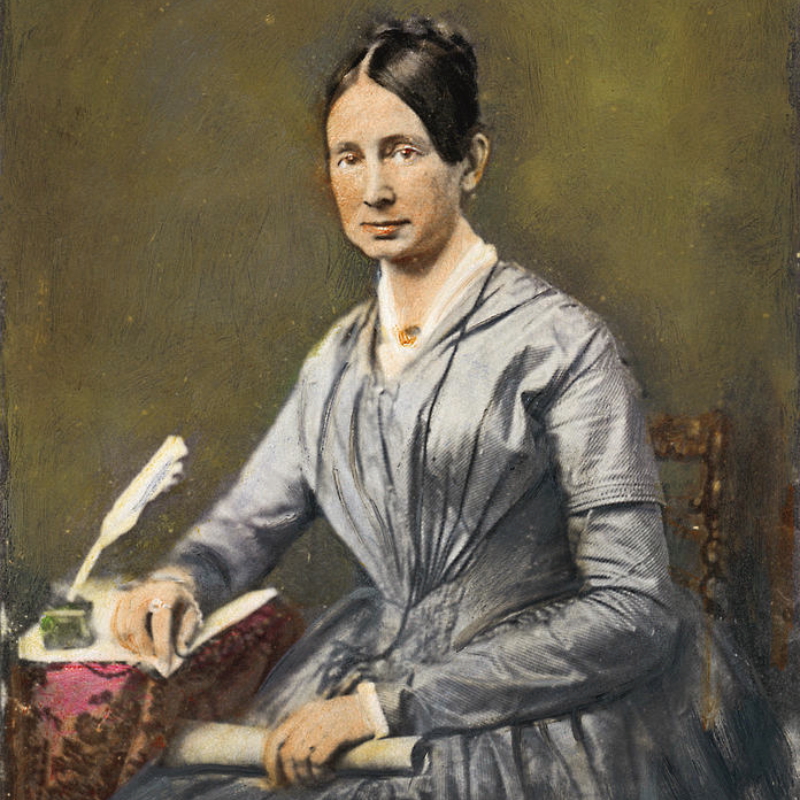
Image source: Fine Art America
Dorothea Dix: Fun Facts
- Full name: Dorothea Lynde Dix
- Birth: April 4, 1802, in Hampden, Maine
- Death: July 17, 1887, in Trenton, New Jersey
- Education: Had no formal nursing education or experience
- Profession: Social reformer, educator, and advocate for the mentally ill
- Key accomplishments: Helped establish over 30 mental health hospitals, fought for humane treatment of people with mental illness, and served as the Superintendent of U.S. Army Nurses during the Civil War
- Published work: Authored multiple books, including Conversations on Common Things (1824), which was reprinted 60 times
Dorothea Dix Biography
1. Early Years and Young Adulthood
Life didn’t start out easy for Dix, who was born in Hampden, Maine, in 1802. As the oldest of three kids, she had to grow up fast, running the household and taking care of her younger siblings. Her mother struggled with serious depression, and her father — a Methodist preacher — was believed to be abusive and battled alcoholism. While still a child, young Dorothea moved to Boston to live with her wealthy grandmother — a change that opened new doors.
Though her schooling had been patchy, she poured herself into learning and, by her early twenties, had become a schoolteacher. Ambitious and determined, she even opened a small school in her grandmother’s home in 1821. Just a few years later, she published Conversations on Common Things, a simple guidebook for teachers that became a hit.
Writing soon became another outlet for her energy. She published religious poetry, stories with moral lessons, and more educational texts — achievements that helped her move into Boston’s intellectual circles. Through her grandmother’s connections, she crossed paths with some of the era’s great thinkers, including Ralph Waldo Emerson and William Ellery Channing, the Father of Unitarianism.
But Dix’s health was fragile. Winters often left her battling a harsh cough and constant fatigue, and by the mid-1830s, she experienced a breakdown that ended her teaching career. Biographers today believe she may have struggled with depression herself.
Friends like Emerson and Channing urged her to rest and arranged for her to travel to England. There, she stayed with a politician, William Rathbone, and met two people who would shape her future path — prison reformer Elizabeth Fry and Samuel Tuke, founder of the York Retreat for the mentally ill.
She returned to Boston in 1837, just after her grandmother’s death. The inheritance she received allowed her to devote herself entirely to charitable work and reform — a choice that would change the course of her life and the lives of many others.
2. First Steps into Reform
In 1841, Dorothea Dix began teaching Sunday school to female inmates at East Cambridge Jail. There, she saw firsthand the inhumane treatment of people with mental illnesses, who were often neglected, chained, and treated with cruelty.
Refusing to look away, Dix launched an investigation into how the mentally ill were treated across Massachusetts and, in 1843, presented her first memorial to the state legislature.
“I come to place before the Legislature of Massachusetts the condition of the miserable, the desolate, the outcast. I come as the advocate of helpless, forgotten, insane, idiotic men and women; of beings sunk to conditions from which the most unconcerned would start with real horror; of beings wretched in our prisons.”
At the time, women had no political voice. They couldn’t vote, hold office, or even speak directly to lawmakers. Her pamphlets had to be read aloud by a male representative, yet being the powerful writer she was — and the fact that her words were so disturbing — she shook the system.
3. Bringing Moral Treatment to America
When something old crumbles, something new must take its place — and Dix had bold ideas for rebuilding America’s broken mental health system.
During her travels in England, she discovered a revolutionary approach to mental health care called traitement moral, or moral treatment. Unlike the brutal methods Dix had seen in American jails and asylums, this approach focused on a highly structured environment, occupational therapy, and activities like art and handicrafts to help patients recover. Physical restraints and harsh discipline were avoided at all costs.
Located in Worcester, Massachusetts, the first asylum influenced by Dix’s relentless advocacy began to receive government funding, freeing countless people from a chained existence and cruel confinement. Many more followed. These facilities didn’t just provide humane custody — they also aimed to heal. Many patients improved, and some even fully recovered, proving that compassionate care could truly make a difference.
After her early victories in Massachusetts, Dix didn’t stop. In 1844, she investigated the conditions of institutions in New Jersey and presented her findings to the state legislature. Her detailed report led to a new asylum approved in 1845.
Dix’s vision went far beyond two states. By 1845, she had traveled over 10,000 miles, inspecting 19 state prisons, 300 county jails, and 500 poorhouses across the U.S. and Canada.
In 1848, Dix raised her campaign to the federal level, petitioning Congress to set aside a portion of profits from public land sales to support the mentally ill, blind, deaf, and mute, as well as abused prisoners. Between 1848 and 1854, she made multiple appeals, but each one failed.
In 1854, her long-awaited reform bill finally passed Congress — only to be vetoed by President Franklin Pierce, who feared it would set a precedent for federal responsibility over “all the poor of the United States.”
Frustrated but not defeated, Dix traveled to the United Kingdom and Europe between 1854 and 1856, where her work was welcomed and reforms advanced. For example, during this time, Dix traveled to Scotland, where she saw the same neglect and cold indifference to human suffering that haunted American institutions. Undeterred, she challenged governments, lawmakers, and communities to take action.
When she returned to the U.S. in 1856, she redoubled her efforts. By 1860, Congress approved funding for the New Jersey State Lunatic Asylum in Trenton — an institution Dix had founded back in 1848 and affectionately called her “firstborn child.”
Dorothea Dix: Civil War Service
When the Civil War broke out in 1861, Dix threw herself into the fight with the same fiery determination she had shown in reform. She was appointed Superintendent of Army Nurses for the Union Army — one of the first women in U.S. history to hold such a powerful federal position. Yet despite the massive responsibility and accolades, the role was unpaid.
One telling story illustrates her personal sacrifice to go on with the role. In 1861, when Dix was working on establishing the Western Sanitary Commission (WSC), she visited her friend Joseph Henry. He noticed her exhaustion and asked why she had walked instead of riding in a horse-drawn wagon. Dix explained that her personal expenses for her “sanitary operations” were so high that she could not afford a carriage.
Henry promptly wrote to Secretary of War Simon Cameron to request a one-horse wagon for Dix’s use, noting that she was “devoting her time and pecuniary means to the welfare of the army … with exertions far beyond a prudent regard for her own health.” President Lincoln approved the suggestion.
Dix politely refused the carriage, writing to Cameron, “I give cheerfully my whole time, mind, strength, and income, to the service of my country,” and insisted she would not “receive any remuneration for what I cheerfully render as a loyal woman.”
Historians offer varied perspectives on Dix’s legacy during this time. Some say she was efficient and effective in her role, calling her a “strict captain.” She insisted her recruits be over 30, plain looking, and disciplined to the core. Harsh? Some thought so, but her system saved lives.
By the end of the war, more than 3,000 women — about 15% of all Union nurses — had served under her command, rewriting both the story of battlefield medicine and the role of women in America.
Yet some historians argue that the same independence that made Dix a powerful reformer left her ill-equipped to navigate the realities of the military and medical systems, and that she proved to be unfit for the task.
One thing that set Dix apart during the war was her refusal to dehumanize the enemy. She insisted that wounded Confederate soldiers get the same care as Union men. Just like Edith Cavell, who treated both Allied and German soldiers during World War I, Dix pushed a simple rule: Tend to need first, politics later.
She stepped down from the position in 1865. After the war, she turned her energy to honoring the fallen, raising funds for a national monument that still stands at Fort Monroe, Virginia.
Dorothea Dix: Accomplishments and Legacy
Dix’s life was defined by relentless advocacy and courage. Her tireless campaigns reshaped society’s view of the mentally ill, leading to the creation of more than 30 state-funded hospitals and legislation mandating humane treatment. By 1890, every state in the U.S. had at least one publicly funded asylum.
But as these hospitals grew, the original idea of moral treatment started to face obstacles. Moral treatment worked best in small hospitals with patients in the early stages of mental illness and enough money and staff to give each person individualized, focused care. In reality, those conditions were hard to meet. Cities were growing fast, and, over time, these asylums became overcrowded and underfunded, focusing more on holding patients than actually treating them.
Dix also quietly, and perhaps unknowingly, pushed the boundaries of women’s roles. In 1843, women could not vote and were expected to remain in the domestic sphere. Dix found a creative way to step into the public arena as a powerful political lobbyist, writing the truth about what she witnessed while men spoke on her behalf — a bold and rare role for a woman of her era.
Though she never officially joined the feminist movement and drew criticism for it, her work still expanded society’s view of women’s capabilities. She argued that her work was a natural extension of traditional female duties, separate from politics, and feared that joining the women’s rights movement would stand in her way of staying focused on her mission.
Dix never married. After decades of tireless service, she spent her later years quietly. Health problems and exhaustion had begun to take their toll, and she retreated from public life, moving to a specially designed suite at the New Jersey State Hospital.
She passed away on July 17, 1887, in Trenton, New Jersey, after nearly six years in the hospital. She was buried in Cambridge, Massachusetts, at Mount Auburn Cemetery, near the lot of William Ellery Channing.
Famous Quotes by Dorothea Dix
Looking for words of inspiration from a woman who didn’t just talk the talk but truly walked the walk? Here are some of Dix’s famous quotes to inspire you:
- We are not sent into this world mainly to enjoy the loveliness therein, nor to sit us down in passive ease; no, we were sent here for action. The soul that seeks to do the will of God with a pure heart, fervently, does not yield to the lethargy of ease.
- My wish is to be known only through my work.
- Time passed solely in the pursuit of pleasure leaves no solid enjoyment for the future, but from the hours you spend reading and studying useful books, you will gather a golden harvest in future years.
- Your mind may now be likened to a garden, which will, if neglected, yield only weeds and thistles; but, if cultivated, will produce the most beautiful flowers and the most delicious fruits.
- They say, “Nothing can be done here!” I reply, “I know no such word in the vocabulary I adopt!”
- Indulged habits of dependence create habits of indolence, and indolence opens the portal to petty errors, to many degrading habits, and to vice and crime with their attendant train of miseries.
- There is, in our nature, a disposition to indulgence, a secret desire to escape from labor, which, unless hourly combated, will overcome and destroy the best faculties of our minds and paralyze our most useful powers.
- All my habits through life have been singularly removed from any condition of reliance on others, and the feeling — right or wrong — that aloneness is my proper position has prevailed since my early childhood, no doubt nourished and strengthened by many and quick-following bereavements.
- A virtuous character is likened to an unblemished flower. Piety is a fadeless bud that half opens on earth and expands through eternity. Sweetness of temper is the odor of fresh blooms, and the amaranth flowers of pure affection open but to bloom forever.
Dorothea Dix Books
Dix was not only a tireless reformer but also a prolific writer. Long before she became known for her advocacy, Dix used her words to educate, inspire, and influence public opinion. Here are some examples of her notable works:
- Conversations On Common Things, Or Guide To Knowledge: With Questions (1828)
- Remarks On Prisons And Prison Discipline In The United States (1845)
- Memorial to the Legislature of Massachusetts (1843)
- Reports of the Illinois State Hospital for the Insane (1847–1862)
Works Inspired by Dix
Dix’s story didn’t end in 1987. Her legacy is still alive in a number of books, movies, hospitals, and monuments all over the world. Here are some examples:
- Dorothea Dix Hospital: A healthcare institution established in 1856 in North Carolina, which provided care for thousands of patients over more than 150 years. It was officially closed in 2012.
- I Tell What I Have Seen (2013): A short animated documentary that tells the story of Dix’s mid-19th-century work to reform mental health care.
- The Life of the Reformer D. Dix by S. Gerolmo: A podcast describing Dix’s accomplishments in mental health, education, and prison reform.
- Books: Various texts mention Dix’s legacy, including Voice for the Mad: The Life of Dorothea Dix by David L. Gollaher, and Heart’s Work: Civil War Heroine and Champion of the Mentally Ill by Charles Schlaifer and Lucy Freeman.
Other Famous Healthcare Heroes
Looking for more inspiring stories from the world of nursing? Discover our features on other famous nurses:
- Clara Barton
- Dorothea Orem
- Florence Nightingale
- Harriet Tubman
- Lucy Higgs Nichols
- Mary Seacole
- Susie Walking Bear Yellowtail
- Walt Whitman
Make a Difference, One Patient at a Time
Inspired by legends like Dorothea Dix? IntelyCare can match you with the best-fitting nursing jobs tailored to what matters most to you. Get access to opportunities designed around your needs and wants.