Creating a Nursing Concept Map: Overview and Examples


A nursing concept map is a powerful tool for organizing and visualizing complex patient information. Imagine caring for a patient who has both asthma and anxiety. The patient’s shortness of breath might trigger anxiety, while the anxiety worsens breathing difficulties — a cycle that can be hard to manage without a clear plan.
A concept map provides a structured overview of a patient’s condition, showing relationships between health problems, symptoms, and interventions to support clinical decision-making.
Ready to learn how to create a concept map? Nursing practice is all about transforming scattered patient information into a visual roadmap — and this guide walks you through it step by step.
What Is a Nursing Concept Map?
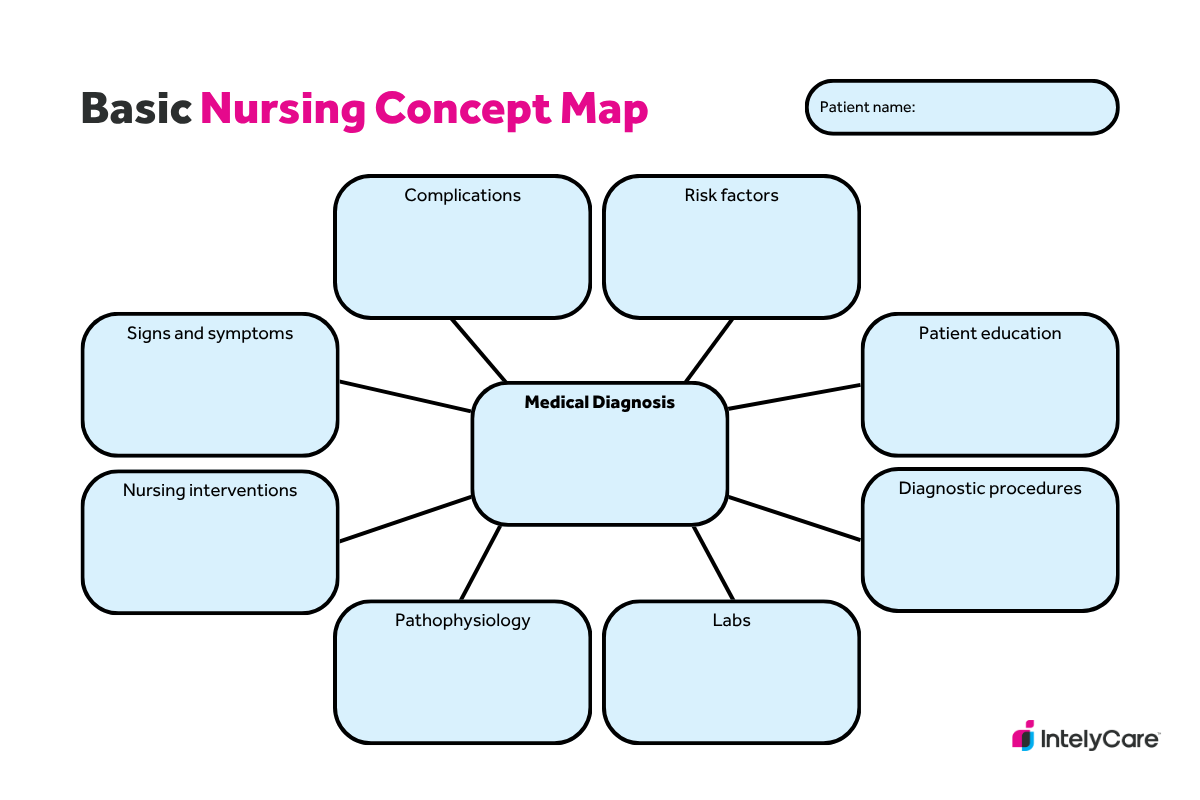
A concept map is a visual diagram that organizes patient information in a structured manner, showing complex relationships between relevant clinical data such as diagnoses, symptoms, and assessment findings. This structured approach not only clarifies complex patient information but also helps nurses develop critical thinking, enhance problem-solving skills, and retain knowledge more effectively over time.
Concept maps may look different depending on their purpose, but they generally consist of the following essential elements:
- Central concept: This is the main focus of the map, typically the patient’s primary diagnosis or health problem, from which all related information extends.
- Related concepts: These are secondary issues or factors connected to the central concept, such as symptoms, risk factors, complications, patient history, or lifestyle factors.
- Links and linking phrases: Arrows connect concepts, often with words or phrases like “leads to,” “aggravated by,” or “managed with,” to illustrate the relationships between ideas.
- Nursing interventions: These are the planned actions or strategies to address identified problems.
- Outcomes: These are the expected results of interventions.
- Assessment data: This section includes data collected from the patient, such as vital signs, lab results, and patient-reported symptoms.
- Prioritization: This involves identifying which issues require immediate attention versus those that can be addressed later, helping nurses organize care effectively.
Types of Nursing Concept Maps
Concept maps aren’t one-size-fits-all — there are different forms depending on their intended purpose. Here are some of the most common types:
| Type of Map | Description | Example |
|---|---|---|
| Spider concept maps | A spider concept map spreads outward from a central idea, with branches that expand into more detail the further they go — think of a web extending from a central point. These maps are great when you want to build on a single theme or idea. | 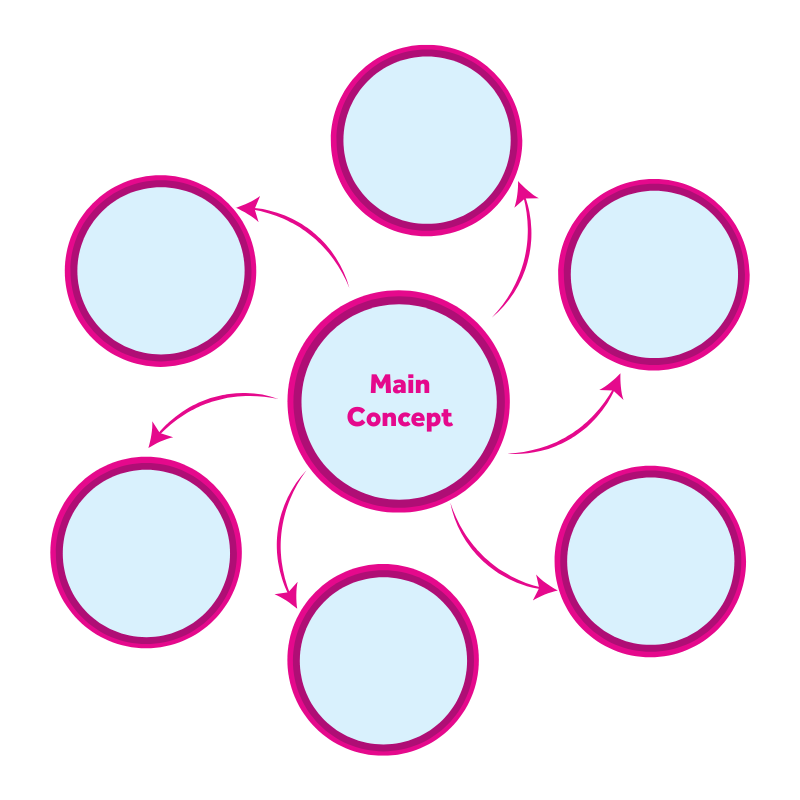 |
| Flow charts | Flow charts organize concepts in a more linear way, usually moving from top to bottom or left to right. They help map out processes, procedures, or decision-making steps. | 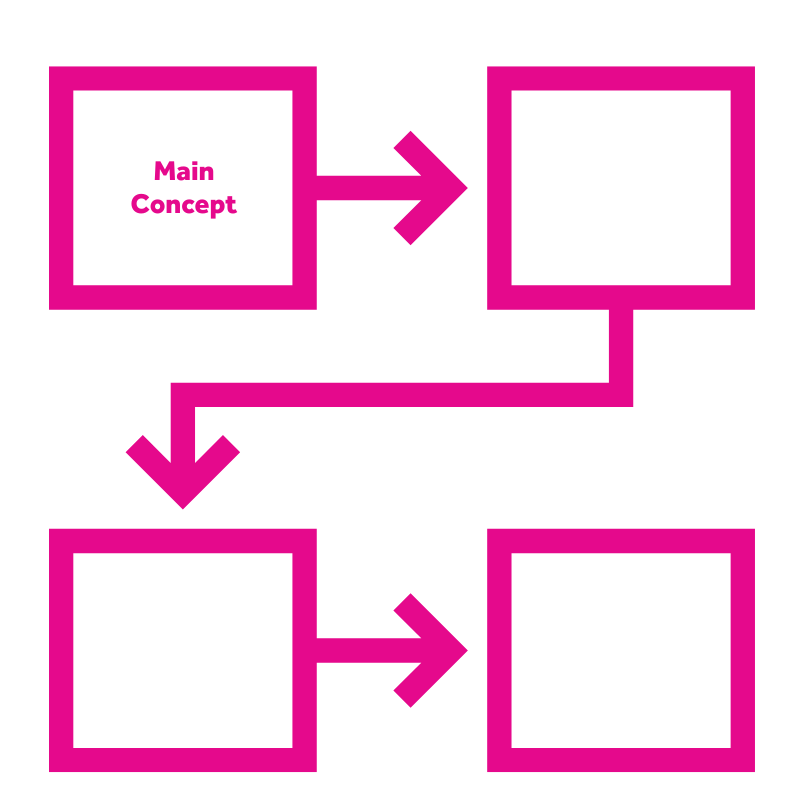 |
| System maps | System maps show all the major components of a system and use arrows to illustrate how the parts relate to one another. They’re useful when you want to understand how a system or team functions as a whole. | 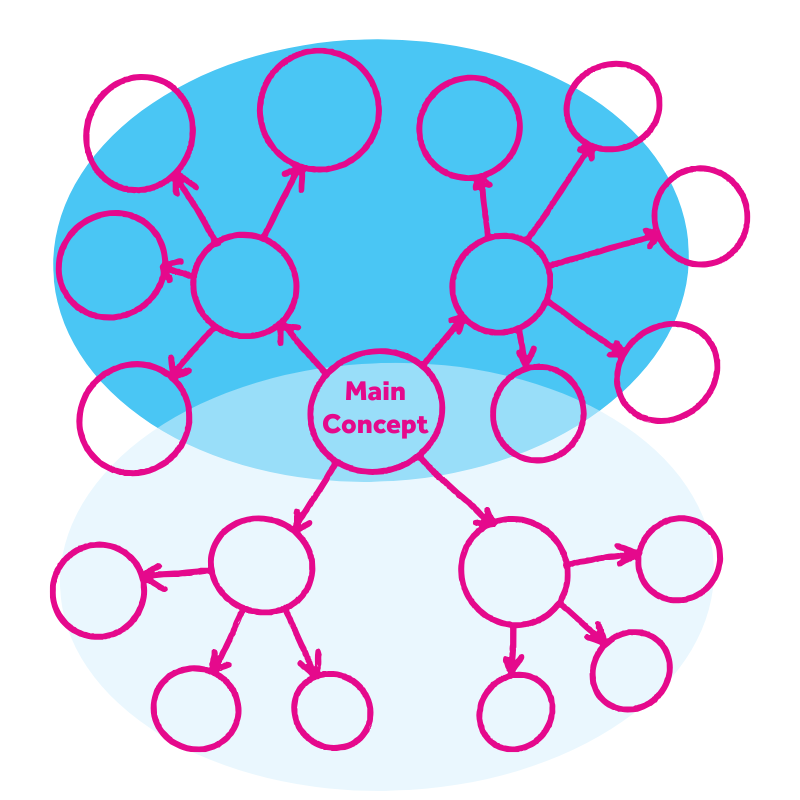 |
| Hierarchy maps | Hierarchy maps resemble family trees or waterfall diagrams, with ideas cascading from top to bottom. They show the elements of a system and their levels of importance, helping you see which parts are at the top, middle, or bottom of the structure. | 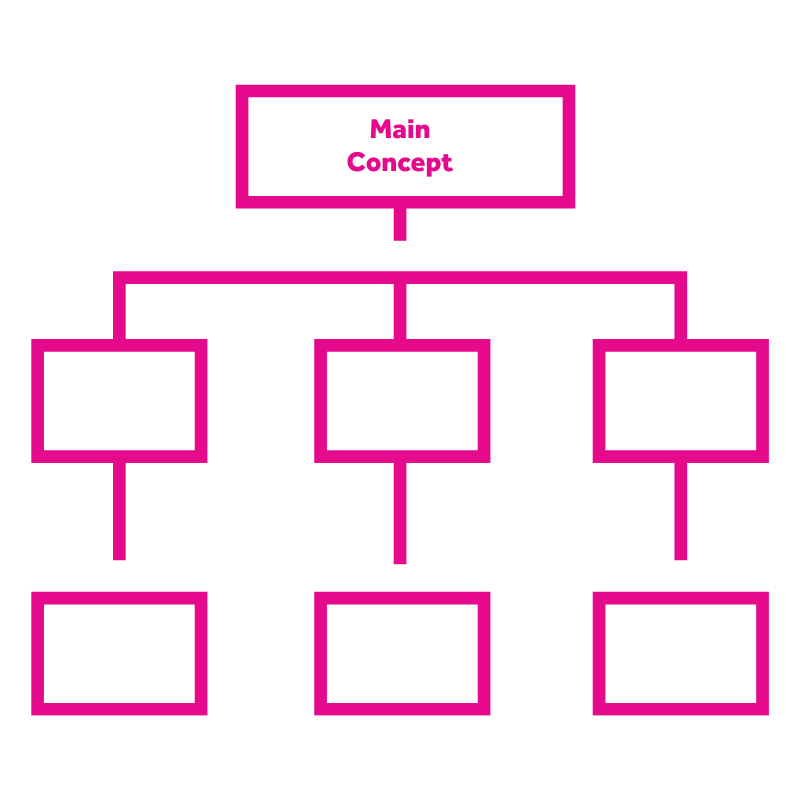 |
Steps of the Concept Mapping Process
The process of concept mapping typically includes six steps, which can be completed in a single day or spread out over weeks, depending on the project.
1. Preparation Step
The preparation step is all about setting the stage for meaningful concept mapping. During this phase, participants establish clear objectives for what the concept map should achieve. Here are the steps of this process:
- Identify participants: Determine the patient or patient cases to be included in the concept map.
- Develop focus: Define the main health issue, diagnosis, or condition that will serve as the central concept of the map.
- Schedule mapping: Set aside dedicated time for brainstorming.
2. Generation Step
During this stage, the goal is to compile a thorough understanding of the patient’s health by collecting subjective and objective data. Here are the types of information you’ll need to gather:
- Objective data points are measurable and observable facts, such as vital signs, laboratory results, and physical examination findings.
- Subjective data points are the patient’s personal experiences and perceptions. This includes information like reported pain levels, feelings of anxiety, or descriptions of symptoms.
3. Structuring Step
In this step, the collected information is organized to reveal patterns, relationships, and priorities. This involves two key activities:
- Sorting statements or data: Participants group similar pieces of information, creating clusters that represent related concepts or themes. Each group is often labeled with a descriptive title to summarize the ideas it contains.
- Rating statements or data: Each item is evaluated for its relative importance, typically using a scale (for example, 1 to 5, where 1 is least important and 5 is most important). This helps highlight which issues require immediate attention.
4. Representation Step
Next, the sorted and rated data are transformed into a visual concept map. This step helps make patterns and relationships between ideas immediately visible. Here are a few things to keep in mind during this step:
- Multidimensional scaling: This statistical technique positions each statement as a point on the map, creating a visual representation of how ideas are related.
- Cluster analysis: This tool takes the output of the multidimensional scaling (the point map) and positions them into clusters or categories, showing overarching themes.
5. Interpretation Step
Once the concept map is visually laid out, the next step is interpretation. This is where nurses take a step back and really look at the map to understand what it’s telling them about the patient’s health. The goal is to identify patterns, connections, and potential gaps in care. During this step, you can ask yourself:
- Are there clusters of information that suggest a bigger underlying problem?
- Which issues are most urgent?
- Are there relationships that weren’t obvious before?
6. Utilization Step
This final step is where the concept map moves from being a visual tool to a practical guide for action. Here, nurses use the completed map to plan care by implementing new strategies.
As the patient’s condition changes, the concept map can be updated to reflect progress or new challenges. In this way, the concept map becomes more than just a diagram — it evolves into a living tool that supports clinical reasoning, communication, and high-quality nursing care.
Nursing Concept Map Examples
Looking for more examples for inspiration? Download our sample concept map below:
If you’re looking for examples with sample information filled in, you can find a wide range of concept maps through both academic and online sources. Here are some options:
- Mobility concept map
- Colon cancer concept map
- AIDS concept map
- Glycolysis and the Krebs cycle concept map
There are also more blank templates online and in educational resources. Here are some examples:
Find a Job You Love With IntelyCare
Now that you know how to create a nursing concept map, let’s find a workplace where your skills can shine. IntelyCare helps you discover nursing jobs that match your goals and preferences, giving you the freedom to work when and where it suits you best.